The Three Musketeers
Alexandre Dumas734descriptions found in the text — easy to miss while reading
Want portraits like these for your book? From $5 — try it→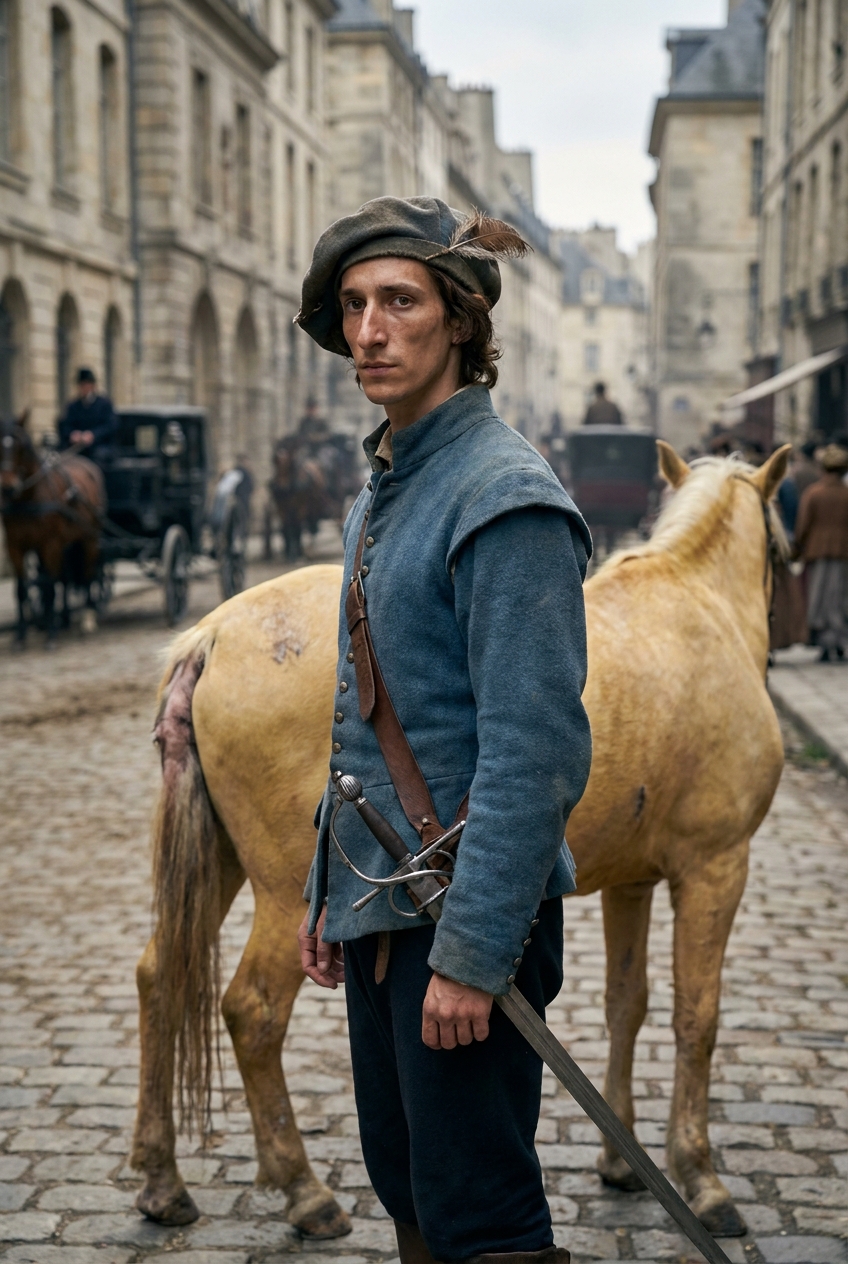
D'Artagnan
Main
Synthesis
A young man of eighteen, with a long, brown face, high cheekbones, and enormously developed maxillary muscles. He has an open, intelligent eye, a hooked but finely chiseled nose. He is too big for a youth, too small for a grown man. He wears a woolen doublet of faded blue, a cap with a feather, and a long sword on a leather baldric. His horse is a Béarn pony, yellow, twelve to fourteen years old, with no hair in its tail and windgalls on its legs.
❝ Imagine to yourself a Don Quixote of eighteen; a Don Quixote without his corselet, without his coat of mail, without his cuisses; a Don Quixote clothed in a woolen doublet, the blue color of which had faded into a nameless shade between lees of wine and a heavenly azure; face long and brown; high cheek bones, a sign of sagacity; the maxillary muscles enormously developed, an infallible sign by which a Gascon may always be detected, even without his cap—and our young man wore a cap set off with a sort of feather; the eye open and intelligent; the nose hooked, but finely chiseled. Too big for a youth, too small for a grown man, an experienced eye might have taken him for a farmer's son upon a journey had it not been for the long sword which, dangling from a leather baldric, hit against the calves of its owner as he walked, and against the rough side of his steed when he was on horseback. ❞
❝ For our young man had a steed which was the observed of all observers. It was a Béarn pony, from twelve to fourteen years old, yellow in his hide, without a hair in his tail, but not without windgalls on his legs, which, though going with his head lower than his knees, rendering a martingale quite unnecessary, contrived nevertheless to perform his eight leagues a day. ❞
❝ D'Artagnan, half stupefied, without his doublet, and with his head bound up in a linen cloth, arose then, and urged by the host, began to descend the stairs ❞
❝ D'Artagnan, in a state of fury, crossed the antechamber at three bounds ❞
❝ D'Artagnan, walking and soliloquizing, had arrived within a few steps of the hôtel d'Arguillon ❞
❝ D'Artagnan, who was by nature very curious—as people generally are who possess the genius of intrigue ❞
❝ D'Artagnan, with his Gascon imagination, saw in it his future fortune ❞
❝ he is little more than a boy; and as he has not the honor of being a Musketeer, he was dressed as a citizen ❞
❝ D'Artagnan, who had no settled habits of his own, as he came from his province into the midst of a world quite new to him ❞
❝ the Gascon is full of ideas ❞
❝ Monsieur d'Artagnan is a young man, scarcely nineteen or twenty ❞
❝ the young man, who detached himself from the wall like a statue walking from its niche ❞
❝ a handsome young man who was so brave and appeared to be so much in love ❞
❝ the young man, with a countenance which indicated not more than twenty years ❞
❝ D'Artagnan was radiant with joy and pride ❞
❝ D'Artagnan blushed up to the whites of his eyes ❞
❝ the young man, with a sword thrust in his breast ❞
❝ D'Artagnan was but twenty years old ❞
❝ his keen eyes plunged through the transparent panes ❞
❝ D'Artagnan, be it remembered, was only twenty years old ❞
❝ he was a very prudent youth ❞
❝ his diamond ring on his finger, his purse in his pocket, and his pistols in his belt ❞
❝ He was a young man... with a lively, intelligent face. ❞
❝ His face was that of a man of twenty, and his eye was that of a man of forty. ❞
❝ He was slender and agile, with a quick temper. ❞
Athos
Main
Synthesis
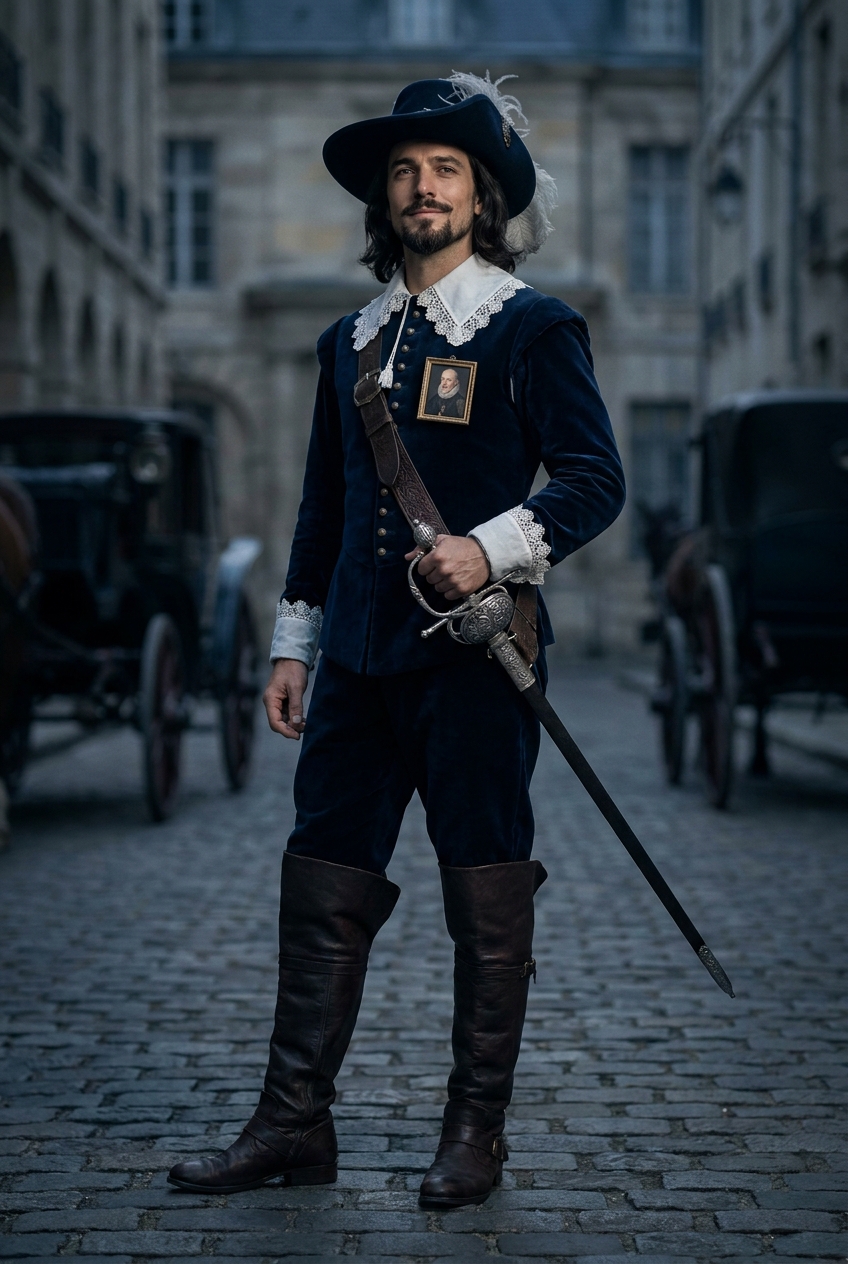
A Musketeer of great personal beauty and intelligence of mind. He is scarcely thirty years old, with a noble countenance and a charming, melancholy smile. He has a noble air, throws back his head and advances his foot with distinction. He is reserved, rough, and silent, making almost an old man of him. He has a sword richly embossed from the times of Francis I, and a portrait of a nobleman resembling him.
❝ At this instant the tapestry was raised and a noble and handsome head, but frightfully pale, appeared under the fringe. ❞
❝ Athos, who still suffered grievously from his wound, though it had been dressed anew by M. de Tréville's surgeon, was seated on a post and waiting for his adversary with hat in hand, his feather even touching the ground. ❞
❝ Athos, wounded anew by Cahusac, became evidently paler, but did not give way a foot. He only changed his sword hand, and fought with his left hand. ❞
❝ Athos, whose keen eye lost nothing, perceived a faintly sly smile pass over the lips of the young Gascon ❞
❝ Athos was scarcely thirty years old, and was of great personal beauty and intelligence of mind ❞
❝ His reserve, his roughness, and his silence made almost an old man of him ❞
❝ Athos instantly took the place which was his due and consigned the ostentatious Porthos to the second rank ❞
❝ Athos would smile, with his charming, melancholy smile, which so became his noble countenance ❞
❝ He had not so noble an air as Athos ❞
❝ Athos played, and that as a rule unfortunately ❞
❝ Athos, who was very expert in all bodily exercises ❞
❝ Athos, faithful to his system of reticence ❞
❝ this gentleman must be thirty at least ❞
❝ Athos, with his habitual calmness ❞
❝ a brave and loyal gentleman ❞
❝ cool Athos ❞
❝ He was of middle height; but his person was so admirably shaped and so well proportioned ❞
❝ His head, with piercing eyes, a straight nose, a chin cut like that of Brutus, had altogether an indefinable character of grandeur and grace. ❞
❝ His hands, of which he took little care, were the despair of Aramis ❞
❝ The sound of his voice was at once penetrating and melodious ❞
❝ His head hanging down, his eye dull, his speech slow and painful ❞
❝ the pale face of Athos appeared ❞
❝ his beautiful eyebrow being heightened or lowered half a line ❞
❝ his hands losing their pearly hue ❞
❝ Athos was a man of about thirty, with a pale, melancholy face. ❞
Porthos
Main
Synthesis
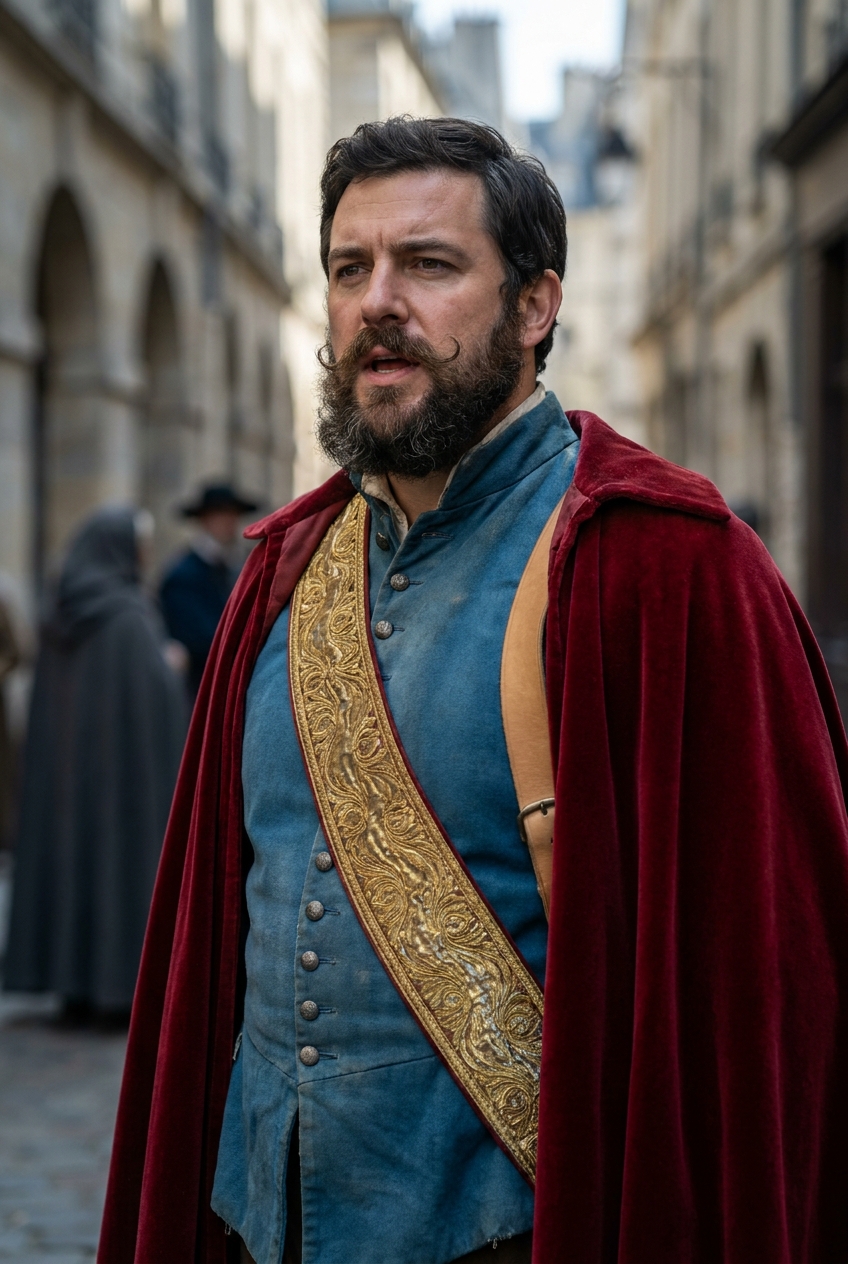
A Musketeer of great height and haughty countenance. He wears a cerulean-blue doublet, a little faded and worn, and over this a magnificent baldric, worked in gold, which shines like water ripples in the sun. A long cloak of crimson velvet falls in graceful folds from his shoulders. He has a self-sufficient tone. He is stout, with a loud voice. He has a baldric that is glittering with gold in the front, but simple buff behind.
❝ The center of the most animated group was a Musketeer of great height and haughty countenance, dressed in a costume so peculiar as to attract general attention. He did not wear the uniform cloak—which was not obligatory at that epoch of less liberty but more independence—but a cerulean-blue doublet, a little faded and worn, and over this a magnificent baldric, worked in gold, which shone like water ripples in the sun. A long cloak of crimson velvet fell in graceful folds from his shoulders, disclosing in front the splendid baldric, from which was suspended a gigantic rapier. ❞
❝ Porthos, who, desirous of taking his turn in the conversation ❞
❝ Porthos, quite beside himself ❞
❝ Porthos, making strong efforts to disembarrass himself of D'Artagnan, who was wriggling about his back ❞
❝ Porthos foamed with rage, and made a movement to rush after D'Artagnan. ❞
❝ Porthos, who carried matters in such a magnificent style ❞
❝ Porthos had his fits. On the days when he won he was insolent and ostentatious ❞
❝ Porthos, who was very expert in all bodily exercises ❞
❝ Porthos made a thousand flourishes ❞
❝ Porthos, one of whose faults was a great looseness of tongue ❞
❝ Porthos, protruding his lips with contempt ❞
❝ Porthos was talking louder than the rest of us ❞
❝ strong and vigorous ❞
❝ the giant whose physical strength was proverbial among the Musketeers ❞
❝ Porthos is a very boastful man ❞
❝ Porthos was a large, strong man with a ruddy face. ❞
❝ He had a thick mustache and a small beard. ❞
❝ He wore rich but often worn-out clothes. ❞
❝ He had a confident, swaggering gait. ❞
❝ Porthos was a man of large stature, with a loud voice and a jovial manner. ❞
❝ He was broad-shouldered and muscular, with a red face and a thick neck. ❞
❝ He had a magnificent mustache and wore rich, flashy clothing. ❞
❝ Porthos was twisting his mustache ❞
❝ Porthos, giving his mustache a twist which was peculiar to him ❞
❝ Porthos, who at the moment wore on his cloak the lace of his own ❞
Aramis
Main
Synthesis
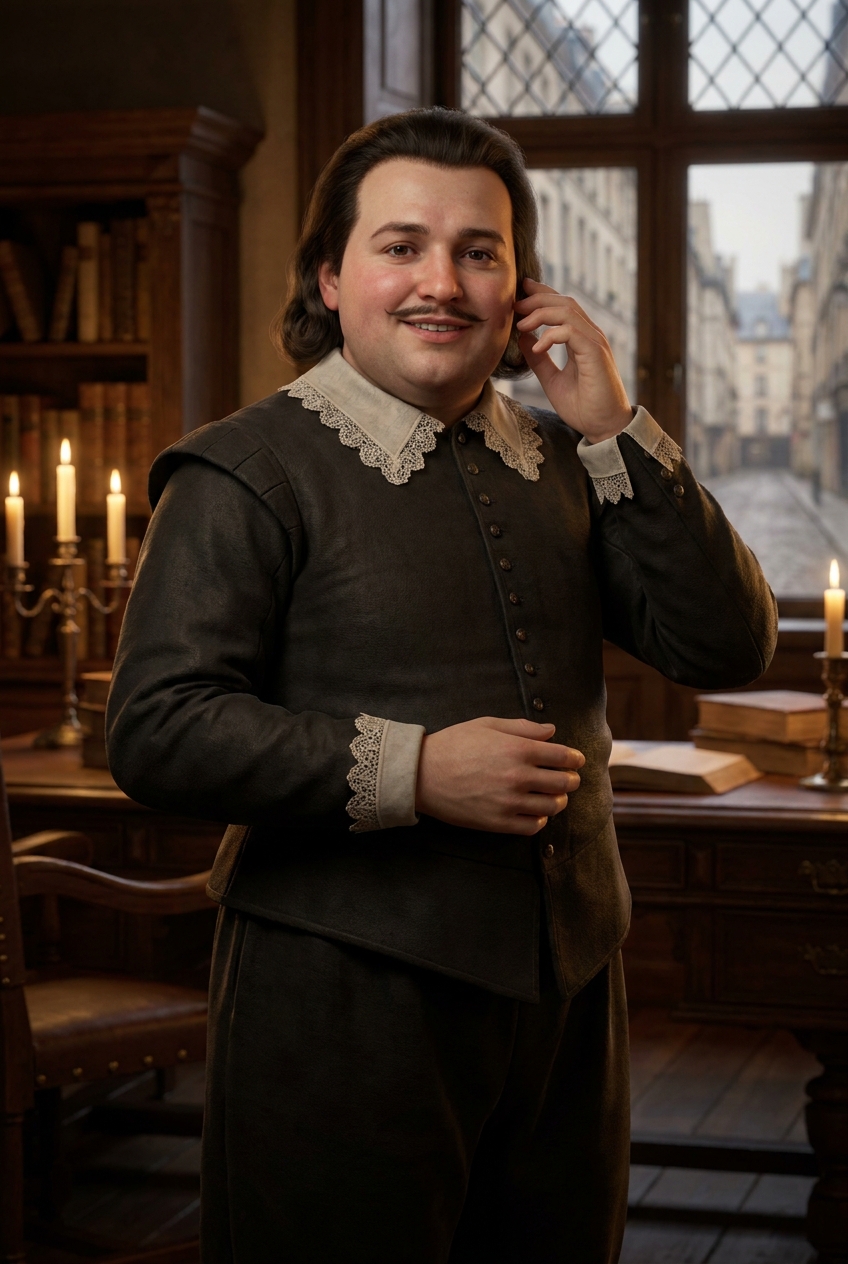
A stout man, of about two- or three-and-twenty, with an open, ingenuous countenance, a black, mild eye, and cheeks rosy and downy as an autumn peach. His delicate mustache marks a perfectly straight line upon his upper lip. He appears to dread to lower his hands lest their veins should swell, and he pinches the tips of his ears from time to time to preserve their delicate pink transparency. He speaks little and slowly, bows frequently, laughs without noise, showing fine teeth. He is mildness and grace personified.
❝ This other Musketeer formed a perfect contrast to his interrogator, who had just designated him by the name of Aramis. He was a stout man, of about two- or three-and-twenty, with an open, ingenuous countenance, a black, mild eye, and cheeks rosy and downy as an autumn peach. His delicate mustache marked a perfectly straight line upon his upper lip; he appeared to dread to lower his hands lest their veins should swell, and he pinched the tips of his ears from time to time to preserve their delicate pink transparency. Habitually he spoke little and slowly, bowed frequently, laughed without noise, showing his teeth, which were fine and of which, as the rest of his person, he appeared to take great care. ❞
❝ Aramis, in his politest tone and with his most graceful bow ❞
❝ Aramis blushed excessively, and snatched rather than took the handkerchief from the hand of the Gascon. ❞
❝ Aramis darted at D'Artagnan one of those looks which inform a man that he has acquired a mortal enemy. ❞
❝ Aramis, resuming his mild air ❞
❝ Aramis, of whom we believe we have sufficiently explained the character—a character which, like that of his companions, we shall be able to follow in its development ❞
❝ Aramis is of the same height, and something of the shape of the duke ❞
❝ I wore an enormous cloak ❞
❝ I had a large hat ❞
❝ Aramis, who, always abstracted by his theological studies ❞
❝ with a foreign accent, which proved to D'Artagnan that he was deceived in one of his conjectures ❞
❝ elegant form and polished manners ❞
❝ a deep sadness imprinted on his countenance ❞
❝ Aramis received a ball which passed through his shoulder ❞
❝ A handsome young man, three- or four-and-twenty years old, mild, amiable, and well made ❞
❝ his hand, which was as white and plump as that of a woman ❞
❝ Aramis, who cultivated his with almond paste and perfumed oil ❞
❝ Aramis, in a black gown, his head enveloped in a sort of round flat cap, not much unlike a calotte ❞
❝ his countenance radiant ❞
❝ Aramis was a handsome young man with a gentle, thoughtful face. ❞
❝ He had dark eyes and hair, and a delicate complexion. ❞
❝ He was elegant and refined, often dressed in a clerical style. ❞
❝ He had a soft voice and a poetic air. ❞
❝ Aramis had a gentle and somewhat effeminate appearance. ❞
❝ He had a pale face, dark eyes, and a soft expression. ❞
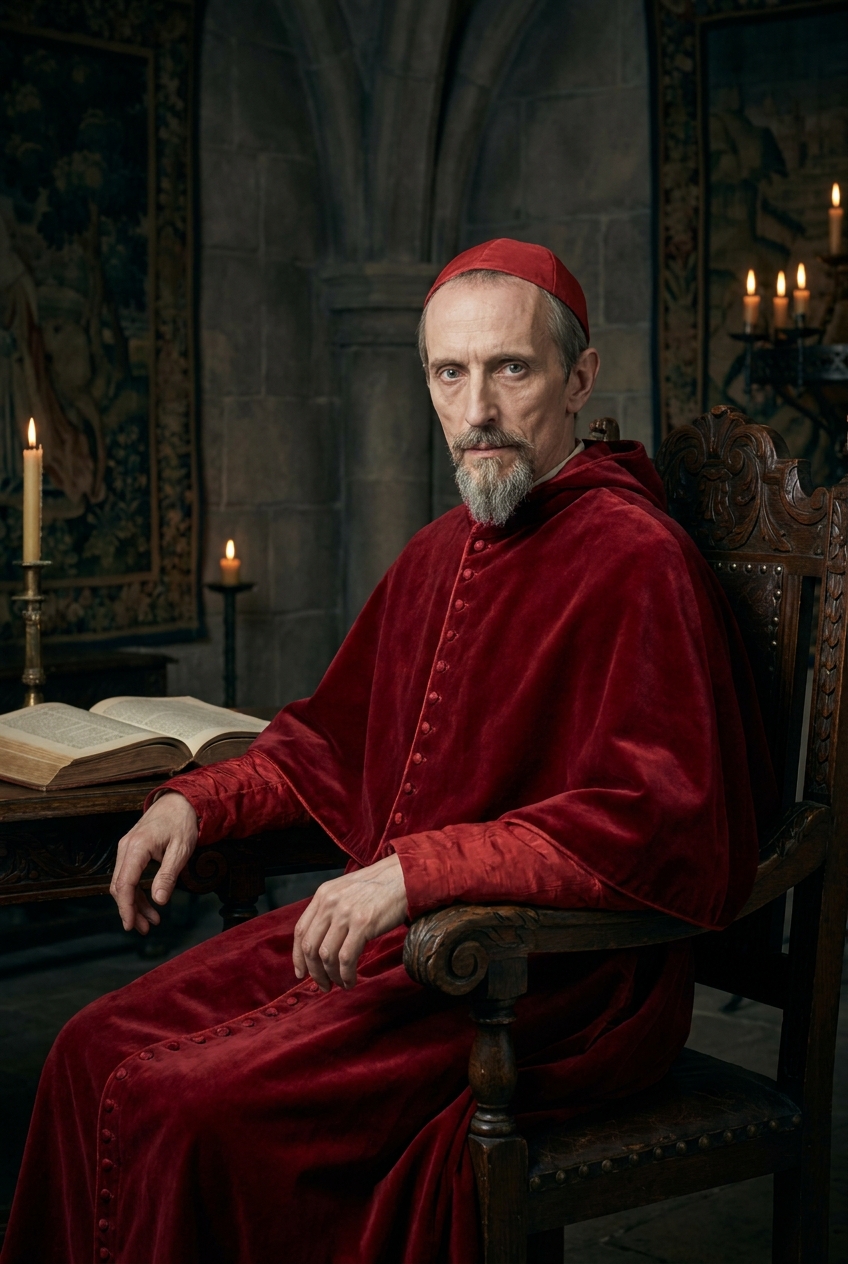
Cardinal Richelieu
Main
Synthesis
A man of middle height, of a haughty, proud mien; with piercing eyes, a large brow, and a thin face, which was made still longer by a royal (or imperial) surmounted by a pair of mustaches. Although scarcely thirty-six or thirty-seven, his hair, mustaches, and royal all began to be gray. He wears buff boots and has the appearance of a soldier.
❝ a man of middle height, of a haughty, proud mien; with piercing eyes, a large brow, and a thin face, which was made still longer by a royal (or imperial, as it is now called), surmounted by a pair of mustaches ❞
❝ Although this man was scarcely thirty-six or thirty-seven years of age, hair, mustaches, and royal, all began to be gray. ❞
❝ his Eminence the cardinal ❞
❝ the pale face of the cardinal ❞
❝ a diabolical smile on his countenance ❞
❝ dressed as a Spanish cavalier ❞
❝ the cardinal’s vengeance was terrible ❞
❝ He was a tall, thin man with a pale, ascetic face. ❞
❝ He had a sharp, intelligent look and a high forehead. ❞
❝ He wore the red robes of a cardinal. ❞
❝ a man seated at a desk and writing... a poet... the cardinal. ❞
❝ He had a pale, thin face, a pointed beard, and a penetrating gaze. ❞
❝ The cardinal fixed his piercing eyes on this courageous speaker. ❞
❝ a clear voice which seemed accustomed to command ❞
❝ the cardinal, who covered a part of his face with his cloak ❞
❝ He was a man of about fifty, with a pale, thin face, a pointed beard, and a penetrating gaze. ❞
❝ He was dressed in the red robes of a cardinal. ❞
❝ He carried himself with an air of authority and cunning. ❞
❝ The cardinal was a man of about forty, with a pale, thin face and a pointed beard. ❞
❝ He had piercing eyes and a commanding presence. ❞
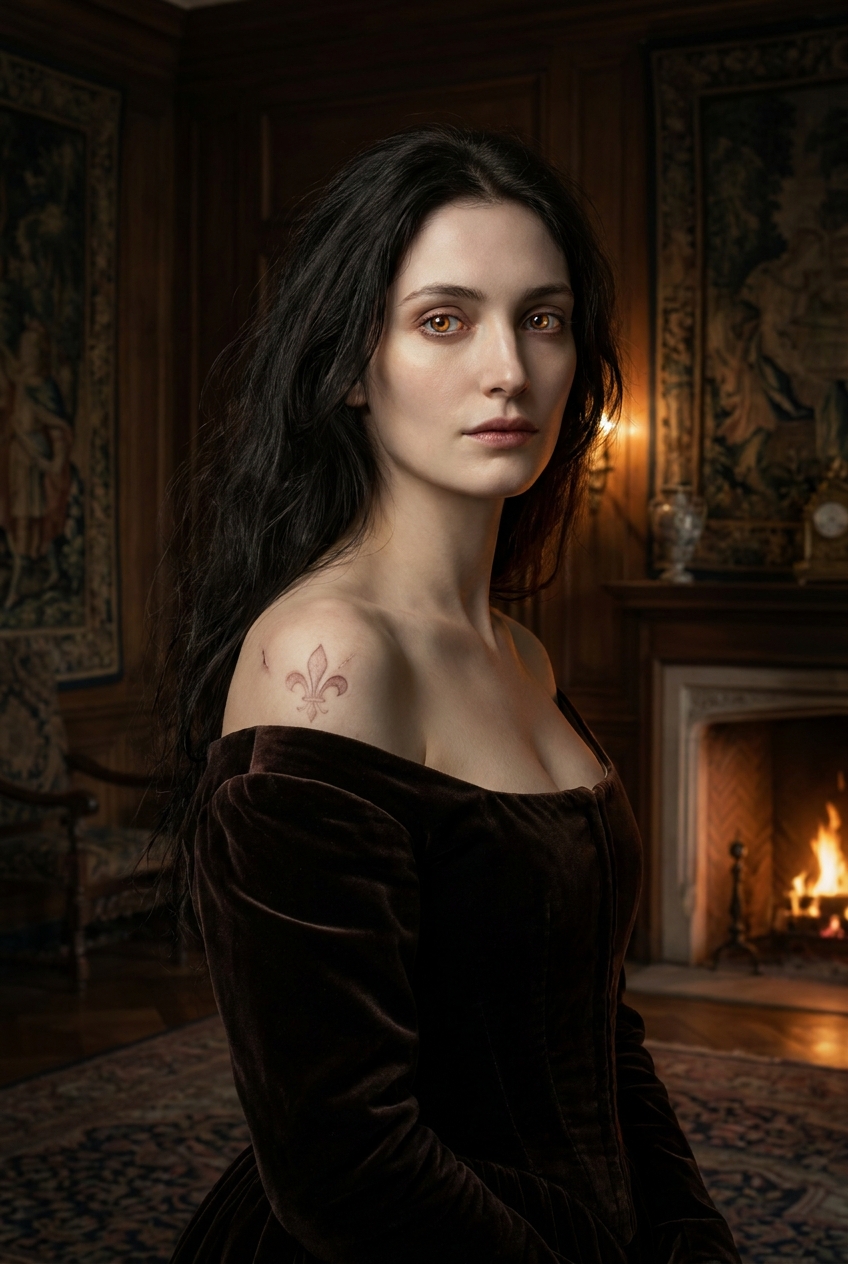
Milady de Winter
Main
Synthesis
A beautiful woman of about twenty-six or twenty-eight years. She has fair hair, blue and clear eyes of a strange brilliancy, with black eyelids and eyebrows. She is tall and well-made. She has a small, rosy fleur-de-lis on her shoulder, which appears to have been partially effaced. She has lost a tooth next to the eyetooth on the left. She dresses elegantly and has a seductive manner.
❝ She was a beautiful woman of about twenty-five, with blonde hair and blue eyes. ❞
❝ She had a pale complexion, a slender figure, and a graceful, seductive manner. ❞
❝ Her eyes were capable of great expression, from fiery anger to languid tenderness. ❞
❝ She was always elegantly dressed. ❞
❝ Her hair was unbound and disheveled, her bosom half bare beneath her crumpled lace. ❞
❝ She was beautiful, pale, and resigned, like a holy virgin awaiting martyrdom. ❞
❝ this woman, so beautiful, fair as the brightest vision ❞
❝ her melodious voice ❞
❝ beautiful as an antique priestess, inspired like a Christian virgin, her arms extended, her throat uncovered, her hair disheveled ❞
❝ her look illumined by that fire ❞
❝ the enchantress had clothed herself with that magic adornment which she assumed and threw aside at will; that is to say, beauty, meekness, and tears ❞
❝ the brand of France!—oh, by that, by that I was branded indeed! ❞
❝ the superhuman beauty of this woman who unveiled herself before him ❞
❝ her beautiful eyes ❞
❝ her noble appearance ❞
❝ the liberality with which she distributed her pistoles ❞
❝ her high air and aristocratic bearing ❞
❝ a woman of a hundred faces ❞
❝ She had a fair complexion and a graceful figure. ❞
❝ She was elegant and seductive. ❞
❝ Her eyes could be both charming and cruel. ❞
❝ She had a mark of a fleur-de-lis on her left shoulder. ❞
❝ She was pale and fair, with long curls falling in profusion over her shoulders, had large, blue, languishing eyes, rosy lips, and hands of alabaster. ❞
❝ She was talking with great animation with the stranger. ❞
❝ Milady, pale as a corpse ❞
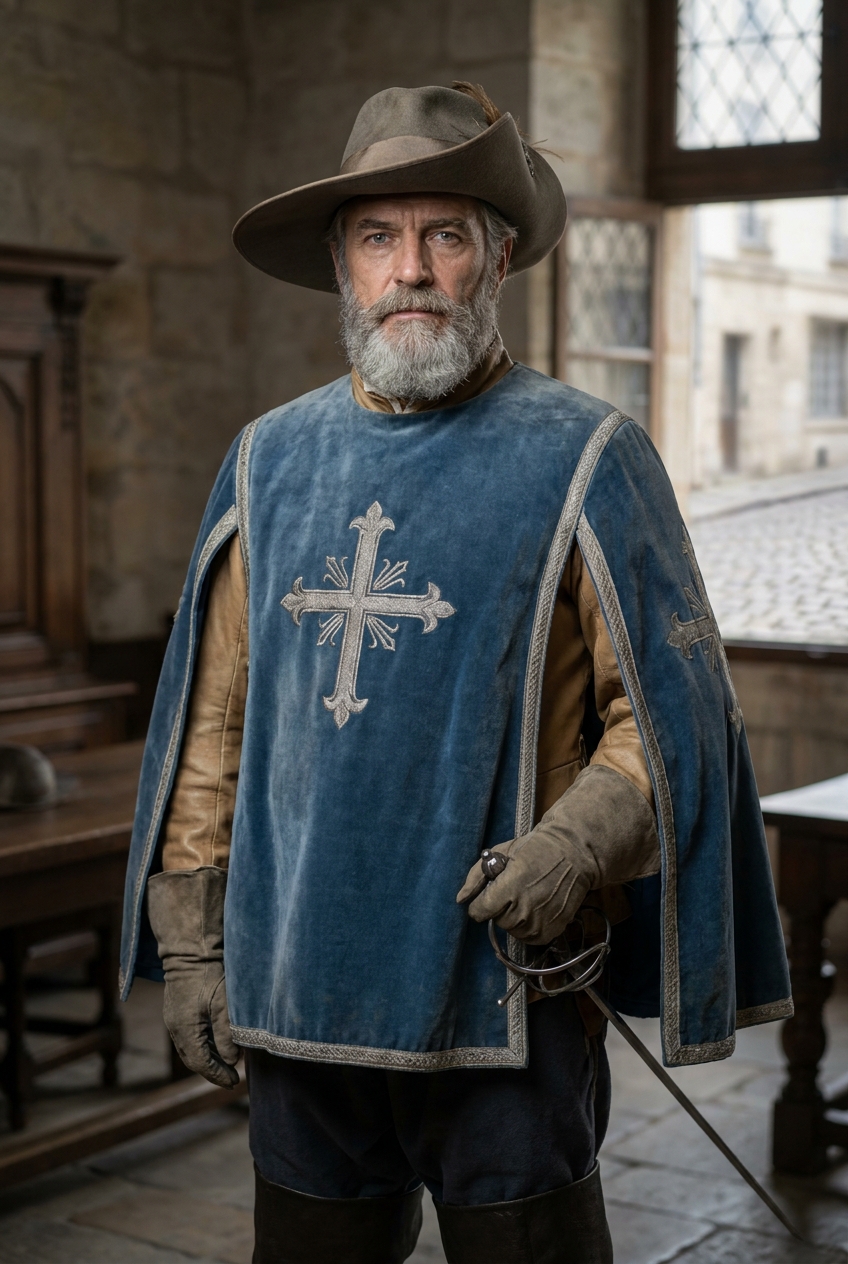
Monsieur de Tréville
Secondary
Synthesis
A captain of the Musketeers, a man of about fifty, with a noble and martial bearing. He has a gray beard and a piercing eye. He is known for his loyalty to the king and his stern but fair demeanor.
❝ M. de Tréville entered, cool, polite, and in irreproachable costume. ❞
❝ He was a man of about fifty, with a noble bearing. ❞
❝ He had a stern, commanding look and gray hair. ❞
❝ Monsieur de Tréville was a man of about fifty, with a noble and martial bearing. ❞
❝ He was a man of about forty, with a noble bearing and a stern, but fair, expression. ❞
❝ M. de Tréville, who had appreciated him at the first glance and who bore him a real affection ❞
❝ this excellent man, whom he had always found worthy, loyal, and great ❞
❝ one who has been thirty years at court ❞
❝ the elegant and noble courtier ❞
❝ his paternal solicitude for his Musketeers ❞
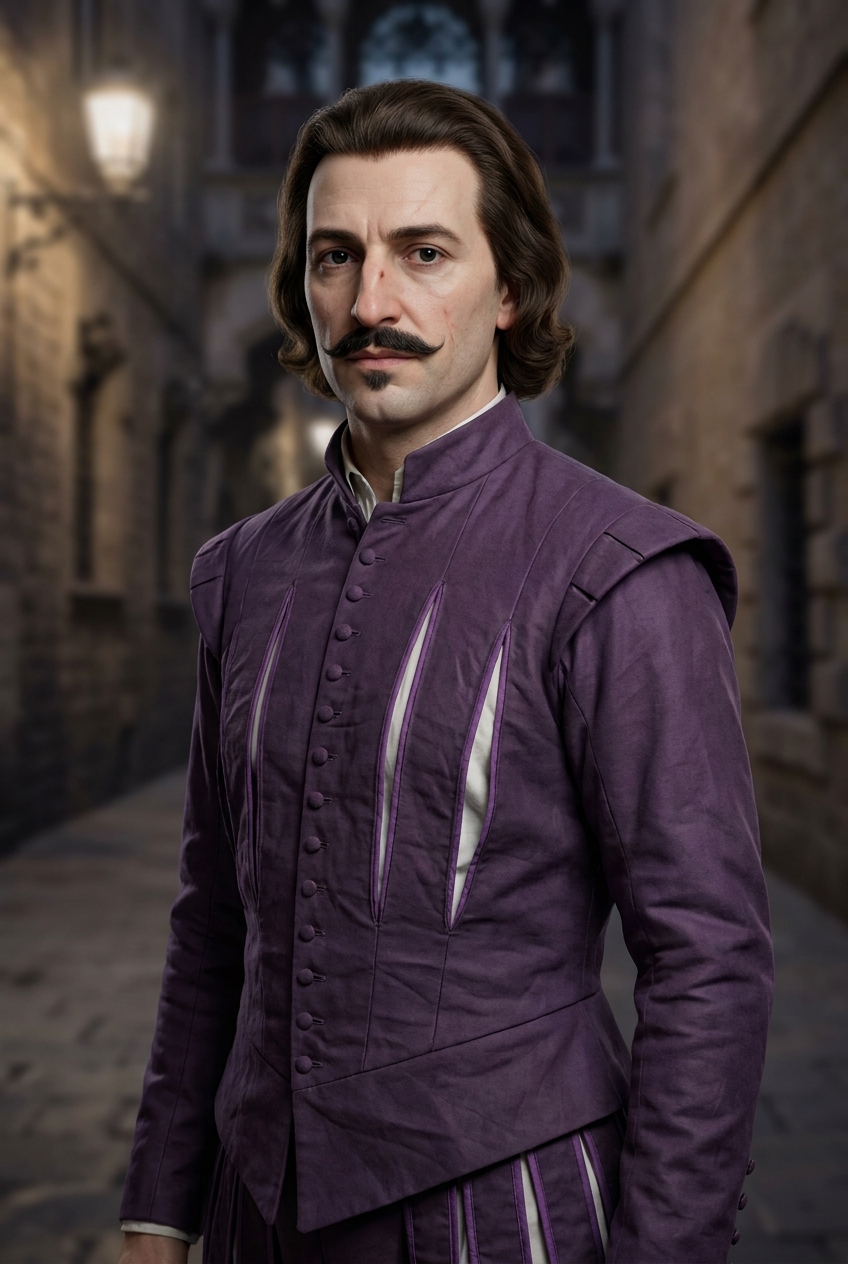
Comte de Rochefort
Secondary
Synthesis
A gentleman of from forty to forty-five years of age, with black and piercing eyes, pale complexion, a strongly marked nose, and a black and well-shaped mustache. He is dressed in a doublet and hose of a violet color, with aiguillettes of the same color, without any other ornaments than the customary slashes, through which the shirt appears. The doublet and hose, though new, are creased, like traveling clothes for a long time packed in a portmanteau. He has a slight scar on his cheek, such as would be made by the grazing of a ball. He is of lofty stature, pale complexion and brown hair.
❝ He fixed his haughty eye upon the stranger, and perceived a man of from forty to forty-five years of age, with black and piercing eyes, pale complexion, a strongly marked nose, and a black and well-shaped mustache. He was dressed in a doublet and hose of a violet color, with aiguillettes of the same color, without any other ornaments than the customary slashes, through which the shirt appeared. This doublet and hose, though new, were creased, like traveling clothes for a long time packed in a portmanteau. ❞
❝ The stranger, then perceiving that the matter went beyond raillery, drew his sword, saluted his adversary, and seriously placed himself on guard. ❞
❝ The stranger, who entertained no doubt that it was the presence of the young man that drove the stranger from his hostelry ❞
❝ The stranger, with a coldly menacing expression ❞
❝ The stranger, muttering to himself, directed his steps toward the kitchen. ❞
❝ the man in the cloak ❞
❝ He was a man of about forty, with a dark, sinister face and a scar on his cheek. ❞
❝ He was a man of about forty, with a dark, sinister appearance. ❞
❝ He was a man of about forty, with a dark, sinister look. ❞
❝ He had a scar on his temple. ❞
❝ He wore a black cloak. ❞
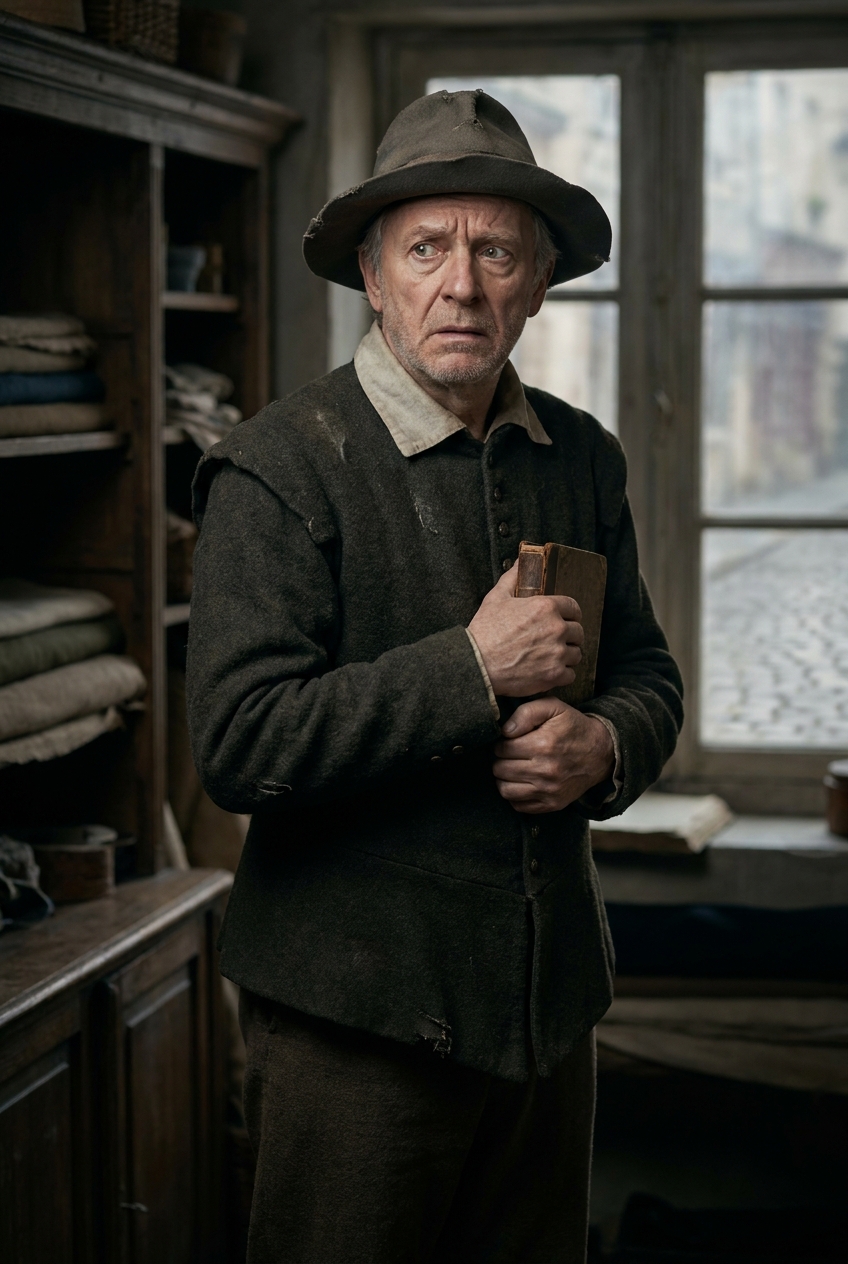
M. Bonacieux
Secondary
Synthesis
A man of fifty, cowardly, avaricious, and foolish. He is a mercer, with a plump, round moneybag. He has a stupid countenance impressed with the invincible resolution of a fool.
❝ the mercer ❞
❝ the unfortunate mercer ❞
❝ You are a shabby old fellow, my dear ❞
❝ a man of fifty ❞
❝ cowardly, avaricious, and foolish ❞
❝ that stupid countenance, impressed with the invincible resolution of a fool ❞
❝ that yellow, sickly paleness which indicates the insinuation of the bile in the blood ❞
❝ something perfidiously significant in the play of the wrinkled features of his countenance ❞
❝ a little man, stout, short, elderly, and commonly dressed in clothes of a dark color ❞
❝ Bonacieux became as pale as death, and grinned a ghastly smile ❞
❝ that his name was Jacques Michel Bonacieux, that he was fifty-one years old, a retired mercer ❞
❝ He was a small, thin man with a worried, timid look. ❞
❝ His face showed his anxiety and greed. ❞
❝ Bonacieux was standing at the door, and looked at D'Artagnan hatefully. ❞
❝ He was a middle-aged man, short and stout. ❞
MB
Mme. Bonacieux
Secondary
Synthesis
A charming woman of twenty-five or twenty-six years, with dark hair, blue eyes, a nose slightly turned up, admirable teeth, and a complexion marbled with rose and opal. Her hands are white but without delicacy; her feet do not bespeak the woman of quality. She has the sweetest smile in the world.
❝ She was a charming woman of twenty-five or twenty-six years, with dark hair, blue eyes, and a nose slightly turned up, admirable teeth, and a complexion marbled with rose and opal ❞
❝ The hands were white, but without delicacy; the feet did not bespeak the woman of quality ❞
❝ Mme. Bonacieux had the sweetest smile in the world ❞
❝ the pretty Mme. Bonacieux ❞
❝ the pretty young woman ❞
❝ her beautiful eyes ❞
❝ the light and intelligent Mme. Bonacieux ❞
❝ quick as a bird she glided between his hands ❞
❝ the beautiful glow which mounted to her cheeks ❞
❝ a young woman, wrapped in a black mantle, who appeared to be very anxious not to be recognized ❞
❝ she was young and pretty ❞
❝ the young woman, with a coquettish smile ❞
❝ what is the most important affair to a woman of twenty-five! Love. ❞
❝ She was a young woman of about twenty-five, with a sweet, pretty face. ❞
❝ She had dark hair and eyes. ❞
❝ She had a gentle, loving expression. ❞
❝ She was a young, pretty woman, with a sweet and gentle face. ❞
❝ She was a young woman of about twenty-five, with dark hair and eyes. ❞
❝ She was pretty and lively. ❞
❝ a young woman of about twenty-five, with a sweet and pretty face. ❞
❝ She had dark hair and eyes, and a gentle expression. ❞
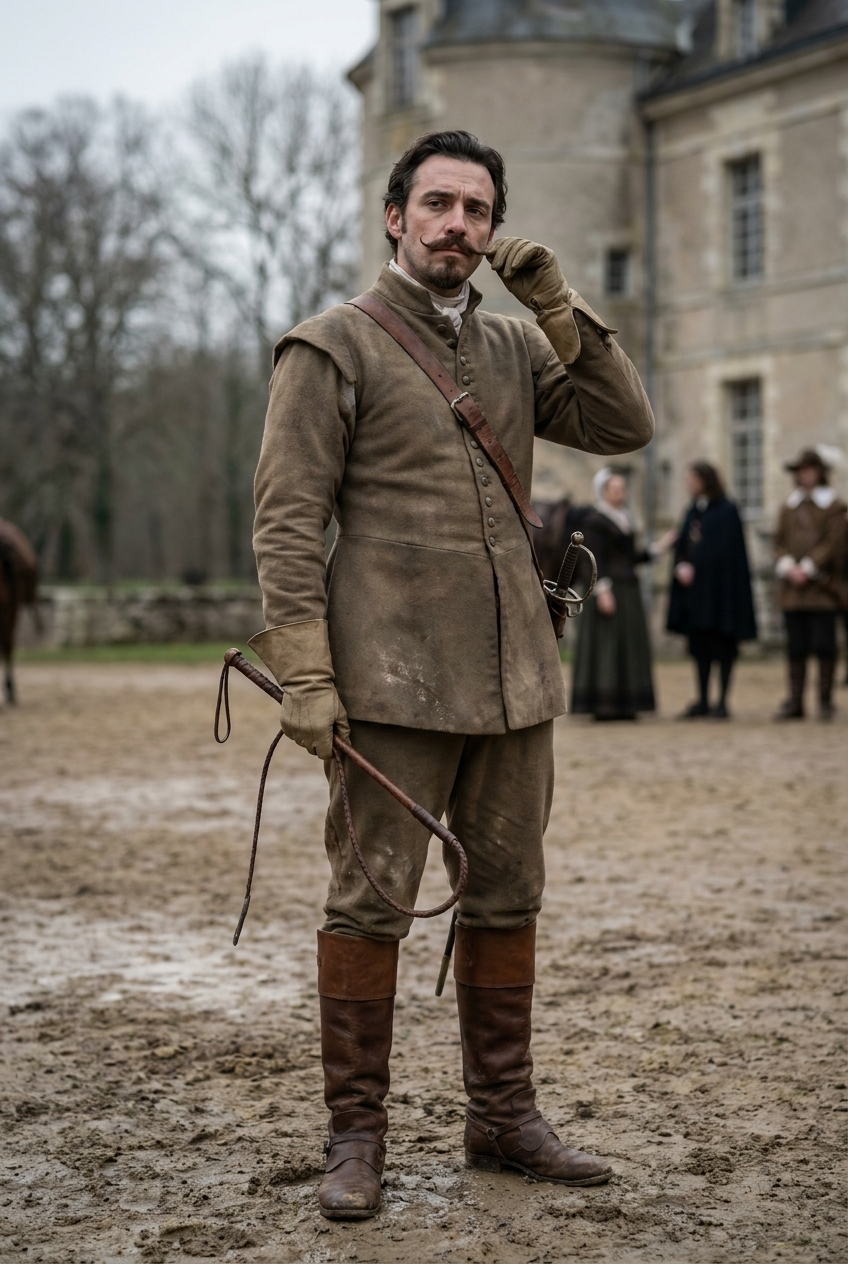
King Louis XIII
Secondary
Synthesis
The king, called Louis the Just. He is avaricious, easily bored, and loves hunting. He wears hunting costume covered with dust, large boots, and holds a whip. He twists his mustache proudly.
❝ Louis XIII. twisted his mustache proudly, placing his hand upon his hip ❞
❝ He was in hunting costume covered with dust, wearing large boots, and holding a whip in his hand ❞
❝ the king was very avaricious ❞
❝ the worst complaint of Louis XIII., who would sometimes take one of his courtiers to a window and say, 'Monsieur So-and-so, let us weary ourselves together.' ❞
❝ in full dress ❞
❝ a most elegant hunting costume ❞
❝ the king looked dull and preoccupied ❞
❝ He was a young king, pale and melancholy. ❞
❝ He had a kind but indecisive expression. ❞
❝ The king was dull and appeared ill, which detracted a little from his usual lofty bearing. ❞
❝ He was a pale, melancholy man, with a weak chin and a hesitant manner. ❞
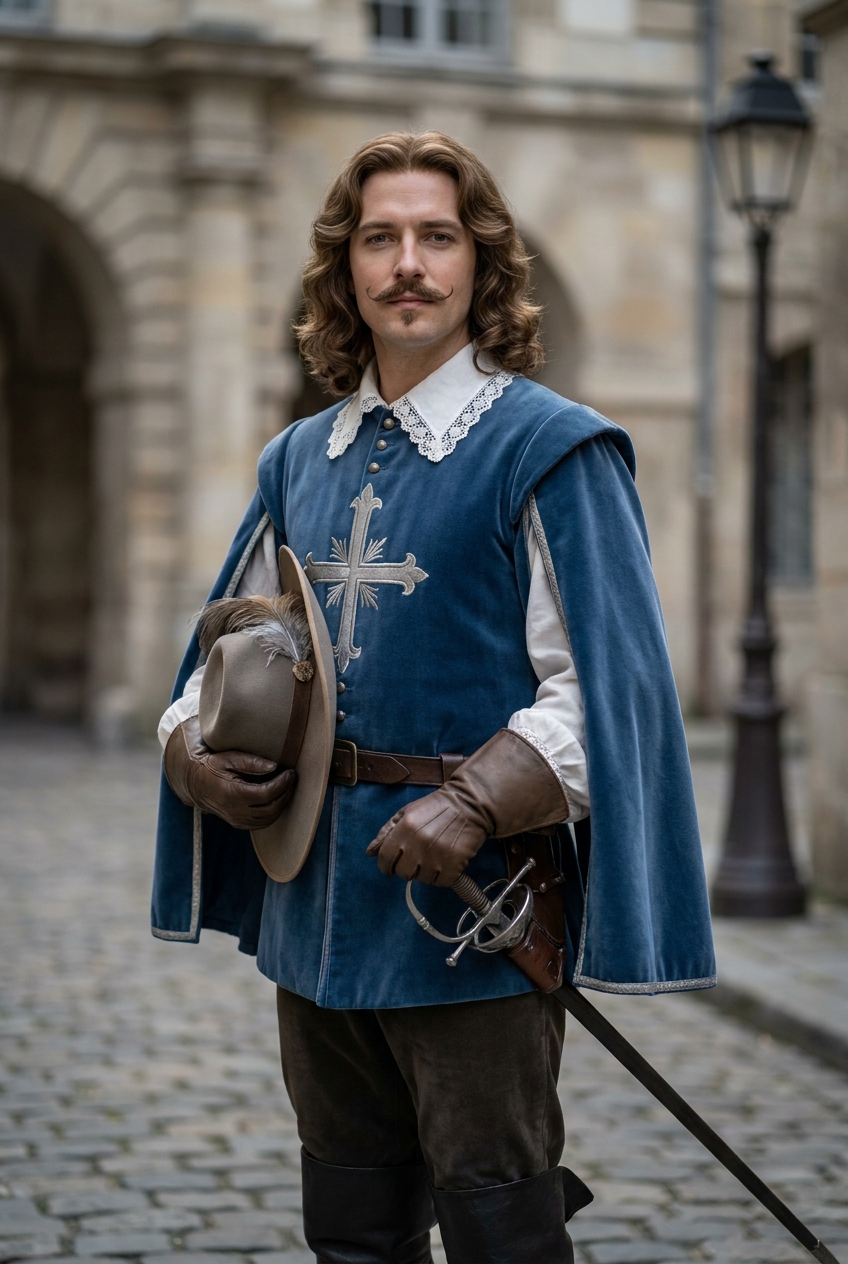
Duke of Buckingham
Secondary
Synthesis
At thirty-five, he is considered the handsomest gentleman and most elegant cavalier of France or England. He has beautiful hair, which he restores the undulations to, and a mustache. He wears a Musketeer's uniform that becomes him marvelously.
❝ I never saw a man with a nobler air than his ❞
❝ he dresses as nobody else can ❞
❝ the handsome young man ❞
❝ becoming as pale as a corpse ❞
❝ uttering a terrible cry ❞
❝ He was a handsome, dashing English nobleman. ❞
❝ He was young and richly dressed. ❞
❝ He was a handsome, dashing man, with a confident, arrogant air. ❞
❝ He was richly dressed, with gold lace and diamonds, and wore a white feather in his hat. ❞
❝ a blue velvet doublet embroidered with pearls ❞
❝ the duke, in a dying voice ❞
❝ At thirty-five, which was then his age, he passed, with just title, for the handsomest gentleman and the most elegant cavalier of France or England. ❞
❝ George Villiers placed himself before the glass... restored the undulations to his beautiful hair, which the weight of his hat had disordered, twisted his mustache ❞
❝ His Musketeer's uniform became him marvelously. ❞
AO
Anne of Austria
Secondary
Synthesis
Twenty-six or twenty-seven years of age, in the full splendor of her beauty. Her carriage is that of a queen or goddess; her eyes cast the brilliancy of emeralds, full of sweetness and majesty. Her mouth is small and rosy, with a slightly protruding underlip. Her skin is velvety soft; her hands and arms of surpassing beauty. Her hair, light in youth, has become chestnut, worn curled plainly with much powder. She has a fine nose, though a sculptor might desire a little more fineness.
❝ Anne of Austria was then twenty-six or twenty-seven years of age; that is to say, she was in the full splendor of her beauty. ❞
❝ Her carriage was that of a queen or a goddess; her eyes, which cast the brilliancy of emeralds, were perfectly beautiful, and yet were at the same time full of sweetness and majesty. ❞
❝ Her mouth was small and rosy; and although her underlip, like that of all princes of the House of Austria, protruded slightly beyond the other, it was eminently lovely in its smile, but as profoundly disdainful in its contempt. ❞
❝ Her skin was admired for its velvety softness; her hands and arms were of surpassing beauty ❞
❝ her hair, which, from being light in her youth, had become chestnut, and which she wore curled very plainly, and with much powder, admirably set off her face ❞
❝ the most beautiful woman in France ❞
❝ a beaver hat with blue feathers, a surtout of gray-pearl velvet, fastened with diamond clasps, and a petticoat of blue satin, embroidered with silver ❞
❝ On her left shoulder sparkled the diamond studs ❞
❝ a slightly foreign accent ❞
❝ She had fair hair and blue eyes. ❞
❝ She was a beautiful woman, with a regal bearing, fair hair and blue eyes. ❞
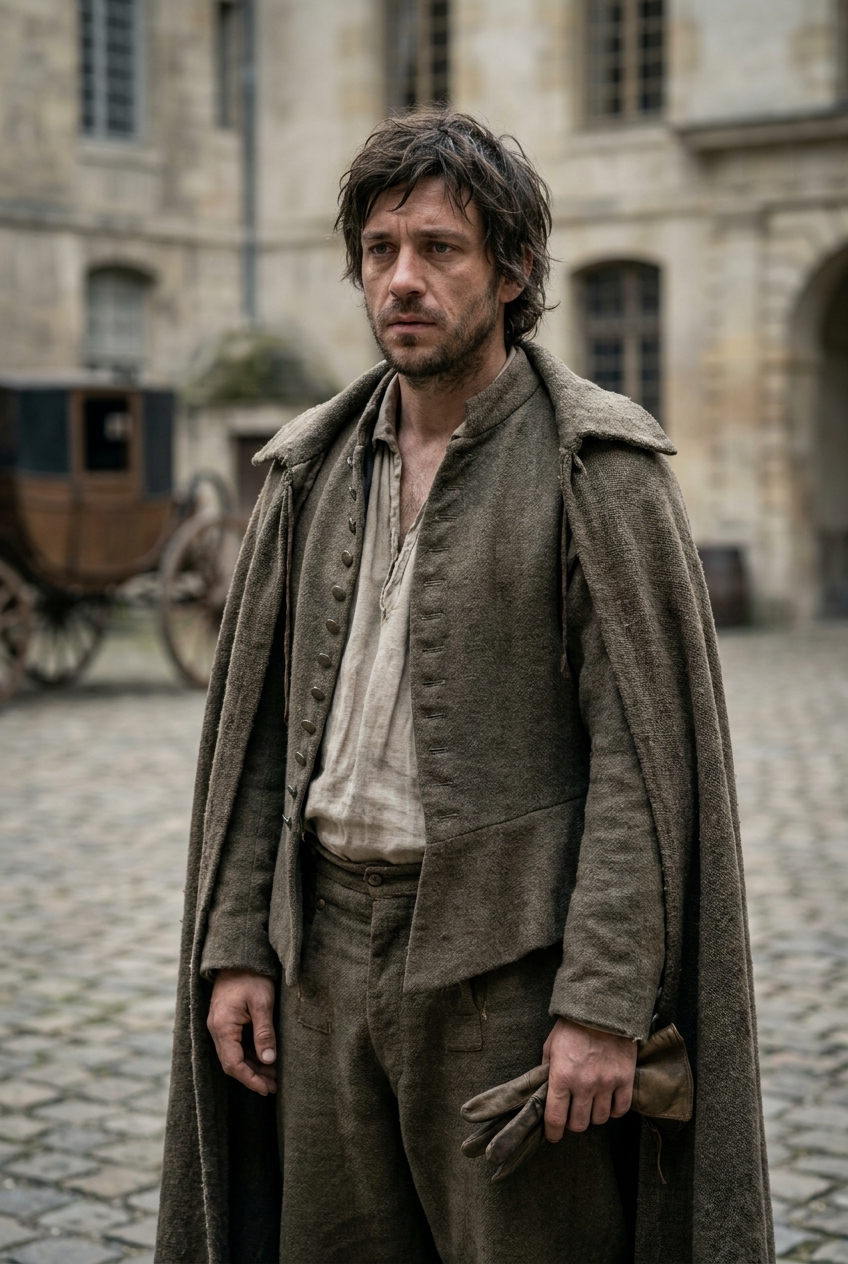
Planchet
Secondary
Synthesis
A Picard, D'Artagnan's lackey. He is initially gay as a chaffinch when well paid, but later complains. He is described as a stupid fellow by D'Artagnan.
❝ He was a Picard, whom the glorious Musketeer had picked up on the Bridge Tournelle, making rings and plashing in the water ❞
❝ Planchet, D'Artagnan's valet, supported his good fortune nobly. He received thirty sous per day, and for a month he returned to his lodgings gay as a chaffinch ❞
❝ I am a Picard. ❞
❝ a brave fellow ❞
❝ strong and vigorous ❞
❝ Planchet, all astonishment, was busy grooming them ❞
❝ Planchet was armed with his musketoon and a pistol ❞
❝ He was a young man from Picardy, intelligent and loyal. ❞
❝ a young man from Picardy, with a ruddy complexion and a lively expression. ❞
❝ Planchet, very proud of being raised to the dignity of landlord ❞
❝ He was a young man, a lackey, with a shrewd, intelligent face. ❞
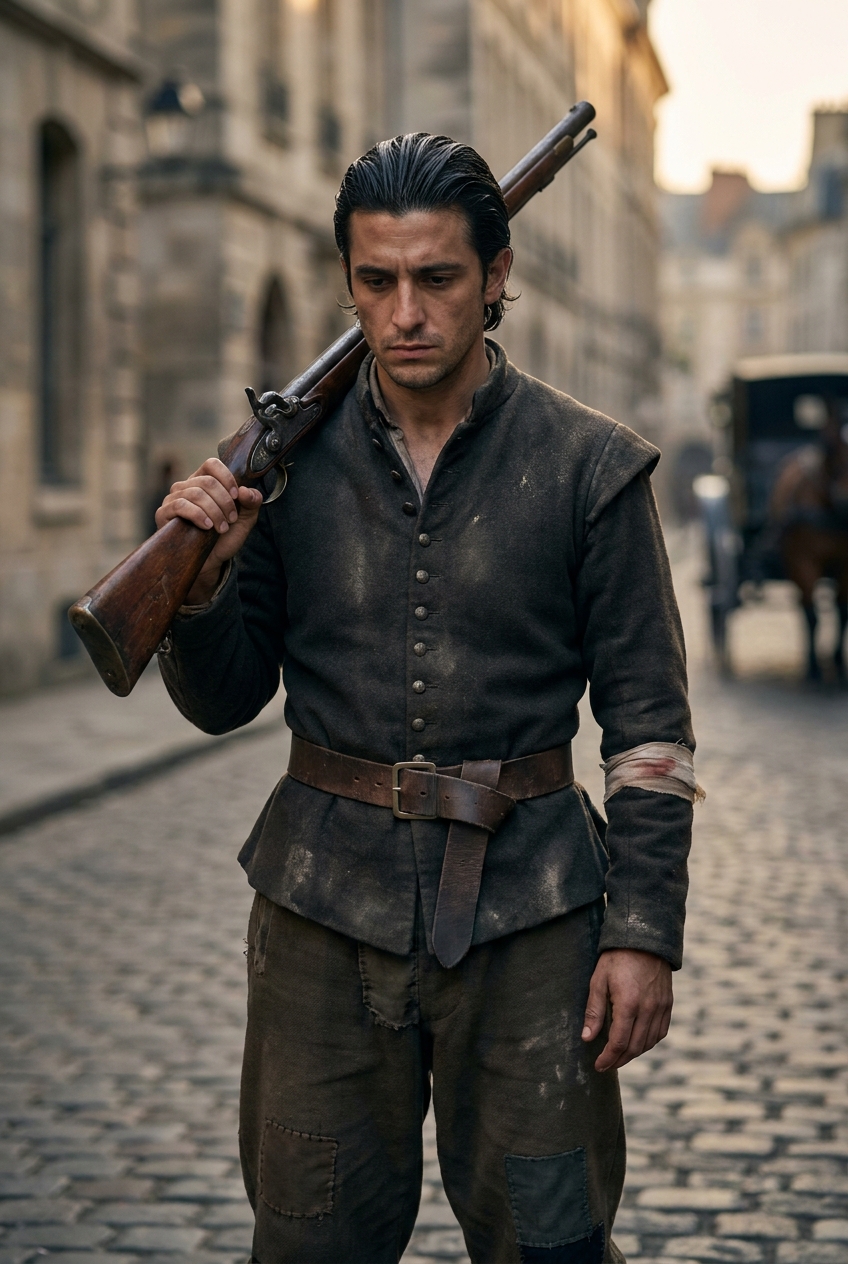
Grimaud
Secondary
Synthesis
Athos's lackey, who speaks little. He is wounded but still serves his master. He appears with a musketoon on his shoulder, shaking his head, moistened with oil.
❝ He was very taciturn, this worthy signor ❞
❝ Grimaud, who feared his master as he did fire, while entertaining a strong attachment to his person and a great veneration for his talents ❞
❝ the poor lad lying senseless, with his head split by a blow with a pitchfork ❞
❝ Monsieur Grimaud (he told us his name, although he does not talk much) ❞
❝ Grimaud appeared in his turn behind his master, with the musketoon on his shoulder, and his head shaking. ... He was moistened before and behind with a greasy liquid ❞
❝ He was a tall, thin man with a mournful expression. ❞
❝ He was silent and obedient. ❞
❝ Grimaud, rubbing his half-open eyes... a taciturn and phlegmatic demeanor. ❞
❝ Grimaud obeyed in silence; the poor lad had nearly come to the pass of forgetting how to speak. ❞
M
Mousqueton
Secondary
Synthesis
Porthos's lackey, a stout and jovial man, with a red face and a loud voice. He is devoted to Porthos and shares his master's love for fine things.
❝ Mousqueton was a Norman, whose pacific name of Boniface his master had changed into the infinitely more sonorous name of Mousqueton ❞
❝ Mousqueton made a very good figure when attending on his master ❞
❝ Mousqueton another ball which lodged in the fleshy part which prolongs the lower portion of the loins ❞
❝ a great degree of intelligence and devotedness in Mousqueton ❞
❝ Mousqueton, with a modest air ❞
❝ He was a stout, cheerful man. ❞
❝ He was devoted to his master and enjoyed good living. ❞
❝ Mousqueton, with a most pitiable air, was driving before him a mule and a horse. ❞
❝ Porthos boasted of the strength of Mousqueton, who was big enough to thrash four men of ordinary size. ❞
B
Bazin
Secondary
Synthesis
Aramis's lackey, always clothed in black, as became the servant of a churchman. He is a Berrichon, thirty-five or forty years old, mild, peaceable, sleek, and of unimpeachable fidelity.
❝ his lackey was called Bazin. Thanks to the hopes which his master entertained of someday entering into orders, he was always clothed in black, as became the servant of a churchman ❞
❝ He was a Berrichon, thirty-five or forty years old, mild, peaceable, sleek, employing the leisure his master left him in the perusal of pious works ❞
❝ Bazin, who had been standing listening to all this controversy with a pious jubilation ❞
❝ Bazin sighed ❞
❝ He was a pious, serious man. ❞
❝ Bazin, curious to know what the mendicant could want with his master, kept pace with him as well as he could. ❞
❝ Bazin was ambitious and learned; he had read history. ❞
MD
M. de Chevalier Dessessart
Secondary
Synthesis
Captain of the Guards, brother-in-law of Monsieur de Tréville. He is a stern and experienced officer.
❝ M. de Chevalier Dessessart ❞
CD
Comte de Wardes
Secondary
Synthesis
A French nobleman, a friend of the cardinal. He is described as a coward with women, but brave with men. No detailed physical description is given.
❝ the handsome young man, who was scarcely twenty-five years of age ❞
❝ a gentleman ❞
❝ He was a young, handsome nobleman with a gallant air. ❞
MC
Madame Coquenard
Secondary
Synthesis
The procurator's wife, a woman of about forty, with a plump figure and a fondness for Porthos. She is described as sensitive and tearful.
❝ the old wife of a procurator of the Châtelet, monsieur, named Madame Coquenard, who, although she is at least fifty, still gives herself jealous airs ❞
❝ She was a sort of ripe beauty, rather yellow and rather dry, but erect and haughty. ❞
❝ She was the wife of a procurator, and somewhat miserly. ❞
❝ Mme. Coquenard recognized her present, and could not at first comprehend this restitution. ❞
LD
Lord de Winter
Secondary
Synthesis
A gentleman of about forty, with a proud, haughty bearing. He has a dark complexion, a strong jaw, and a sarcastic smile. He is dressed in the English fashion, with a sword at his side.
❝ He was a tall, handsome English nobleman. ❞
❝ He had light hair and a fair complexion. ❞
❝ Lord de Winter is only her brother-in-law. ❞
❝ He was a gentleman of about forty, with a proud, haughty bearing. ❞
❝ He had a dark complexion, a strong jaw, and a sarcastic smile. ❞
❝ this man, in whom Milady till that time had only seen a very simple gentleman, had become an admirable jailer ❞
❝ He was armed at all points ❞
❝ He was a man of about thirty, with a stern and noble bearing. ❞
K
Kitty
Secondary
Synthesis
A young maid, about twenty years old, with a pale face and sad eyes. She is slender and has a gentle, loving nature. She is devoted to D'Artagnan.
❝ She was a pretty young woman of about twenty, with a lively, fresh face. ❞
❝ She had a gentle, loving nature. ❞
❝ poor girl, pale as death and trembling in all her limbs. ❞
❝ a month of fever could not have changed her more than this one night of sleeplessness and sorrow. ❞
❝ a young woman with light hair and delicate complexion ❞
❝ the habit of a novice, which the young woman wore ❞
MC
Monsieur Coquenard
Secondary
Synthesis
An old man of seventy-six, thin and dry, with little gray eyes that shine like carbuncles. He is a procurator, and is very stingy.
❝ He was an old man of seventy-six, thin and dry. ❞
❝ His little gray eyes shone like carbuncles. ❞
❝ M. Coquenard, whose little gray eyes sparkled with anger. ❞
JF
John Felton
Secondary
Synthesis
A young officer of about twenty-five or twenty-six, with a pale complexion, clear blue eyes rather deeply set, a fine, well-cut mouth, and a strongly marked chin. His brow is a little receding, shaded by short thin hair of a beautiful deep chestnut color. He has a calm, impassive countenance, and a stern, Puritanical demeanor.
❝ He was a young man of about twenty-five or twenty-six, with a pale complexion, clear blue eyes rather deeply set. ❞
❝ His mouth was fine and well cut, his chin strongly marked. ❞
❝ His brow was a little receding, shaded by short thin hair of a beautiful deep chestnut color. ❞
❝ He had a calm, impassive countenance. ❞
❝ He was pale as usual, but with his eye inflamed and almost wild. ❞
❝ The young man was more pale than usual, and his eyes, reddened by want of sleep ❞
❝ his brow was armed with a severity more austere than ever ❞
❝ Felton grew frightfully pale, and a convulsive tremor crept through his whole body ❞
❝ the sweat streamed down his marble forehead ❞
❝ his hand, under his coat, tore his breast ❞
J
Jussac
Episodic
Synthesis
One of the cardinal's Guardsmen, a first swordsman. He is wounded by D'Artagnan.
❝ Jussac, one of the first swordsmen in the kingdom ❞
❝ Jussac, who had risen upon his elbow ❞
C
Cahusac
Episodic
Synthesis
A cardinal's Guardsman, killed by Athos.
❝ Cahusac fell, with a sword thrust through his throat ❞
B
Bicarat
Episodic
Synthesis
A cardinal's Guardsman, a Gascon like D'Artagnan. He is one of those iron men who never fell dead. He has a wound in his thigh.
❝ Bicarat was one of those iron men who never fell dead ❞
❝ with a wound in his thigh ❞
MD
Monsieur d'Artagnan the Elder
Episodic
Appearance not described
MD
Madame d'Artagnan
Episodic
Appearance not described
TH
The Host of the Jolly Miller
Episodic
Appearance not described
MD
Monsieur de Laigues
Episodic
Appearance not described
C
Chalais
Episodic
Appearance not described
MD
Madame d'Aguillon
Episodic
Appearance not described
MD
Madame de Bois-Tracy
Episodic
Appearance not described
M
Montaran
Episodic
Appearance not described
B
Bernajoux
Episodic
Synthesis
A cardinal's Guardsman, known for daily brawls. He has a sword thrust in his arm and another through his lungs.
❝ the name of Bernajoux was known to all the world ❞
❝ in addition to the sword thrust in his arm, which is not dangerous, he has received another right through his lungs ❞
MD
M. de la Trémouille
Episodic
Synthesis
A duke, a Protestant, a man of courage and honor. He is a royal gentleman.
❝ M. de la Trémouille—a Protestant, and seeing the king seldom—was of no party ❞
❝ Both were men of courage and honor ❞
LC
La Chesnaye
Episodic
Synthesis
The king's confidential valet, who never leaves the door.
❝ Louis XIII.'s confidential valet, who never left the door ❞
L
Laporte
Episodic
Synthesis
The queen's cloak bearer and valet de chambre, godfather of Mme. Bonacieux.
❝ Monsieur Laporte, the queen's cloak bearer ❞
G
Germain
Episodic
Synthesis
A concierge at the Louvre wicket on the Rue de l'Echelle.
❝ Germain ❞
B
Boisrenard
Episodic
Synthesis
Leader of the posse that arrests Bonacieux.
❝ Boisrenard ❞
TS
The stranger from Meung
Episodic
Synthesis
A noble of very lofty carriage, black hair, swarthy complexion, piercing eye, white teeth, and a scar on his temple. He is a creature of the cardinal.
❝ a noble of very lofty carriage, black hair, swarthy complexion, piercing eye, white teeth, and has a scar on his temple ❞
❝ a man wrapped in a cloak ❞
MS
Monsieur Séguier (Keeper of the Seals)
Episodic
Synthesis
A pleasant man, formerly a valet of a bishop, later chancellor. He is described as half smiling, half blushing. He has a reputation for being a terrible possessed from his convent days. Physical appearance not detailed.
❝ The chancellor entered, half smiling, half blushing. ❞
DE
Donna Estafania
Episodic
Synthesis
The queen's Spanish companion, who followed her from Madrid. Physical appearance not described.
MD
Madame de Lannoy
Episodic
Synthesis
The queen's tire-woman, devoted to the cardinal. Physical appearance not described.
MD
Madame de Chevreuse
Episodic
Synthesis
A beautiful and influential noblewoman, friend of the queen and lover of Aramis.
MD
Monsieur de Guitant
Episodic
Synthesis
Captain of the Guards. Physical appearance not described.
MD
Madame de Guitaut
Episodic
Synthesis
One of the queen's women. Physical appearance not described.
MD
Madame de Sable
Episodic
Synthesis
One of the queen's women. Physical appearance not described.
MD
Madame de Montbazon
Episodic
Synthesis
One of the queen's women. Physical appearance not described.
MD
Madame de Guémené
Episodic
Synthesis
One of the queen's women, who reads aloud. Physical appearance not described.
V
Vitray
Episodic
Synthesis
A messenger of the cardinal, booted and spurred. Physical appearance not described.
❝ An instant after, the man he asked for was before him, booted and spurred. ❞
CD
Comte de Châlus
Episodic
Synthesis
A gentleman present at Tréville's. Physical appearance not described.
MD
Madame de Surgis
Episodic
Synthesis
A woman who slept in the queen's chamber. Physical appearance not described.
MD
Monsieur de Laffemas
Episodic
Synthesis
The cardinal's executioner, a monster.
P
Patrick
Episodic
Synthesis
Buckingham's confidential valet, who speaks French perfectly well.
❝ the confidential valet of the duke, who, having accompanied him in all his voyages, spoke French perfectly well ❞
MO
Mr. O'Reilly
Episodic
Synthesis
An Irish goldsmith, one of the most skillful of his craft, who gains a hundred thousand livres a year by the Duke of Buckingham.
❝ an Irishman—one of the most skillful of his craft, and who himself confessed that he gained a hundred thousand livres a year by the Duke of Buckingham ❞
L
Lubin
Episodic
Synthesis
The lackey of the Comte de Wardes, a Norman, described as obstinate.
❝ I know him for a Norman, and Normans are obstinate ❞
SD
Sieur de la Coste
Episodic
Synthesis
Ensign in the king's Guards.
D
Duhallier
Episodic
Synthesis
Captain of the Guards.
C
Clement
Episodic
Synthesis
City registrar.
ML
Madame la Première Présidente
Episodic
Synthesis
The most considerable personage of the fête after the queen.
ML
M. le Comte de Soissons
Episodic
Synthesis
Noble accompanying the king.
GP
Grand Prior
Episodic
Synthesis
Noble accompanying the king.
DD
Duc de Longueville
Episodic
Synthesis
Noble accompanying the king.
DD
Duc d'Eubœuf
Episodic
Synthesis
Noble accompanying the king.
CD
Comte d'Harcourt
Episodic
Synthesis
Noble accompanying the king.
CD
Comte de la Roche-Guyon
Episodic
Synthesis
Noble accompanying the king.
MD
M. de Liancourt
Episodic
Synthesis
Noble accompanying the king.
MD
M. de Baradas
Episodic
Synthesis
Noble accompanying the king.
CD
Comte de Cramail
Episodic
Synthesis
Noble accompanying the king.
CD
Chevalier de Souveray
Episodic
Synthesis
Noble accompanying the king.
MJ
Mr. Jackson
Episodic
Synthesis
Buckingham's secretary.
TC
The Captain of the vessel
Episodic
Synthesis
The captain of the ship that carries Milady to England.
GO
Governor of the port
Episodic
Synthesis
The governor of the port at Calais.
HO
Host of the Golden Lily
Episodic
Synthesis
The host at Amiens, with a candlestick and cotton nightcap, appearing honest but treacherous.
❝ The host had the appearance of as honest a man as any on earth. He received the travelers with his candlestick in one hand and his cotton nightcap in the other. ❞
HA
Host at St. Valery
Episodic
Synthesis
A fisherman's hut host, who gives D'Artagnan a horse.
HA
Host at Neufchâtel
Episodic
Synthesis
Host of the Golden Harrow tavern.
HA
Host at Eccuis
Episodic
Synthesis
Host of the Shield of France tavern.
MD
M. d'Estrées
Episodic
Synthesis
Owner of a pavilion at St. Cloud.
MD
M. de Benserade
Episodic
Synthesis
A literary figure quoted by Tréville.
MD
M. de Cavois
Episodic
Synthesis
Captain of the cardinal's Guards. He is described as 'all honey' in manner.
❝ he was all honey, monsieur ❞
TH
The Host of the Great St. Martin
Episodic
Synthesis
An innkeeper at Chantilly, respectful and talkative. He is worried about his debts.
❝ the host, on seeing a young man followed by a lackey with two extra horses, advanced respectfully to the door ❞
TH
The Host of the Inn at Amiens
Episodic
Synthesis
An innkeeper who falsely accused Athos of coining. He is pale and trembling when confronted.
❝ The host became as pale as death ❞
❝ the host, in the most pitiable voice imaginable ❞
TO
The Old Man at St. Cloud
Episodic
Synthesis
An old man living in a cottage near the pavilion. He is poor and fearful. He has a head that appears at the window, pale.
❝ the head of an old man ❞
❝ the same face appeared, only it was now still more pale than before ❞
TJ
The Jesuit of Amiens
Episodic
Synthesis
A learned ecclesiastic, enthusiastic about theology. He is dressed in black.
❝ the superior of the Jesuits of Amiens ❞
TC
The Curate of Montdidier
Episodic
Synthesis
A curate, who echoes the Jesuit. He is dressed in black.
❝ the curate of Montdidier ❞
TT
The Two English Gentlemen
Episodic
Synthesis
Two gentlemen, one of whom speaks very good French with a foreign accent. They are exasperated and hungry.
❝ two English gentlemen just arrived ❞
TB
The Boatman at St. Cloud
Episodic
Synthesis
A ferryman who took a young woman across the river. He noticed she was young and pretty.
❝ the boatman had taken over a young woman, wrapped in a black mantle ❞
TH
The Hostess at Crèvecœur
Episodic
Synthesis
A plump, cheerful woman, the mistress of the inn where Aramis stayed.
❝ the plump, cheerful countenance of the mistress of the place ❞
TG
The Gascon Priest
Episodic
Synthesis
A priest who gave the four friends a breakfast of chocolate. No further description.
TS
The Stranger (who fought Porthos)
Episodic
Synthesis
A gentleman who fought Porthos and won his horse. He is described as a stranger, no further details.
TL
The Leader of the Abduction Party
Episodic
Synthesis
A tall, dark man with black mustaches, dark eyes, and the air of a gentleman.
❝ A tall, dark man, with black mustaches, dark eyes, and the air of a gentleman. ❞
TL
The Little Old Man (in the abduction)
Episodic
Synthesis
A little man, stout, short, elderly, and commonly dressed in clothes of a dark color. He is not a gentleman, does not wear a sword.
❝ a little man, stout, short, elderly, and commonly dressed in clothes of a dark color ❞
MD
Monsieur de Nogaret de la Valette
Episodic
Synthesis
A cardinal who makes campaigns, mentioned in dialogue. No description.
MV
Monsieur Voiture
Episodic
Synthesis
A great man who complimented Aramis on his rondeau. No description.
MP
Monsieur Patru
Episodic
Synthesis
Mentioned as a lawyer whose pleadings are successful. No description.
TO
The Officer (who insulted Aramis)
Episodic
Synthesis
An officer who insulted Aramis and was later killed by him. No description.
TL
The Lady (Aramis's mistress)
Episodic
Synthesis
The mistress of the house where Aramis read his verses. She is described as giving compliments and leaning on his shoulder. No further description.
TE
The Englishman (Lord de Winter's friend)
Episodic
Synthesis
An English gentleman, opponent in the dice game. Appearance not described.
TH
The Host of the Inn at Chantilly
Episodic
Synthesis
A man who is easily frightened and complains about losses. Appearance not described.
TP
The Procurator's Clerks
Episodic
Synthesis
Three clerks, one tall and pale, one shorter, one taller, and a boy of twelve. They are hungry and eager for food.
❝ A tall, pale clerk, his face shaded by a forest of virgin hair... a shorter clerk came behind the first, a taller clerk behind the second, a stripling of a dozen years rising behind the third. ❞
TJ
The Jesuit and the Curate
Episodic
Synthesis
Two clergymen who dine with Aramis. Appearance not described.
TG
The Goatkeeper
Episodic
Synthesis
A man who tends goats behind the Luxembourg. Appearance not described.
TE
The Englishman's Coachman
Episodic
Synthesis
A coachman who receives the purse from Athos. Appearance not described.
MD
Monsieur (Duc d'Orléans)
Episodic
Synthesis
The king's brother, a prince of the blood. He is described as having a commanding presence.
CD
Comte de Toiras
Episodic
Synthesis
A French commander in the Isle of Ré. No detailed physical description.
BD
Baron de Chantal
Episodic
Synthesis
A French nobleman killed in the fight at the Isle of Ré. No physical description.
LH
La Houdinière
Episodic
Synthesis
Captain of the cardinal's guards. No physical description.
B
Bassompierre
Episodic
Synthesis
A French nobleman, Protestant and Catholic, commander at the siege of La Rochelle. No physical description.
DD
Duc d'Angoulême
Episodic
Synthesis
A French nobleman, commander at the siege of La Rochelle. No physical description.
B
Brisemont
Episodic
Synthesis
A convalescent soldier, a would-be assassin who repents. He is wounded and dies in agony.
❝ the false soldier who had tried to kill D'Artagnan ❞
❝ Brisemont, stretched upon the ground and rolling in horrible convulsions ❞
F
Fourreau
Episodic
Synthesis
A lackey of one of D'Artagnan's guests, pale with terror.
❝ Fourreau, as pale as death ❞
MD
Monsieur de Busigny
Episodic
Synthesis
A light-horseman, with a handsome watch studded with diamonds.
❝ drawing from his fob a very handsome watch, studded with diamonds ❞
G
Godeau
Episodic
Synthesis
Purveyor of the Musketeers.
S
Schomberg
Episodic
Synthesis
Marshal of France.
M
Montague
Episodic
Synthesis
An envoy of the Duke of Buckingham, captured.
B
Bois-Robert
Episodic
Synthesis
A person mentioned in the cardinal's threats.
MD
Marquis de Beautru
Episodic
Synthesis
A person mentioned in the cardinal's threats.
CD
Chevalier de Guise
Episodic
Synthesis
A person whose costume Buckingham borrowed.
CD
Claude de St. Simon
Episodic
Synthesis
A person who took flags to Paris.
MM
Marie Michon
Episodic
Synthesis
A seamstress in Tours, cousin of Aramis. Her writing is large and coarse.
TS
The Swiss
Episodic
Synthesis
A Swiss soldier who drinks with the Musketeers.
TD
The Dragoon
Episodic
Synthesis
A dragoon who drinks with the Musketeers.
TW
The Woman of the neighbourhood
Episodic
Synthesis
A woman sent to attend Milady in her captivity.
TS
The Soldier on guard
Episodic
Synthesis
A soldier guarding Milady's door.
AO
Abbess of the Carmelite Convent
Episodic
Synthesis
The daughter of a noble house, with a smiling and prudent manner. Her appearance is not described in detail.
KC
King Charles I of England
Episodic
Synthesis
The King of England. His appearance is not described in the provided text.
JB
Jack Butler
Episodic
Synthesis
A captain of a sloop. His appearance is not described in the provided text.
PD
Prince de Soubise
Episodic
Synthesis
A deputy from La Rochelle. His appearance is not described in the provided text.
HA
Hostler at Arras
Episodic
Synthesis
A hostler. His appearance is not described in the provided text.
EO
Executioner of Lille
Episodic
Synthesis
A tall man with a pale complexion, black hair and beard. He wears a red cloak. He is the brother of the priest seduced by Milady.
❝ He was a tall man, with a pale complexion, black hair and beard. ❞
MD
Monsieur de Putange
Episodic
Synthesis
An acquaintance of Milady, mentioned in conversation.
MD
Monsieur Dujart
Episodic
Synthesis
An acquaintance of Milady, mentioned in conversation.
MD
Monsieur de Louvigny
Episodic
Synthesis
A Musketeer mentioned by Milady.
MD
Monsieur de Courtivron
Episodic
Synthesis
A Musketeer mentioned by Milady.
MD
Monsieur de Ferussac
Episodic
Synthesis
A Musketeer mentioned by Milady.
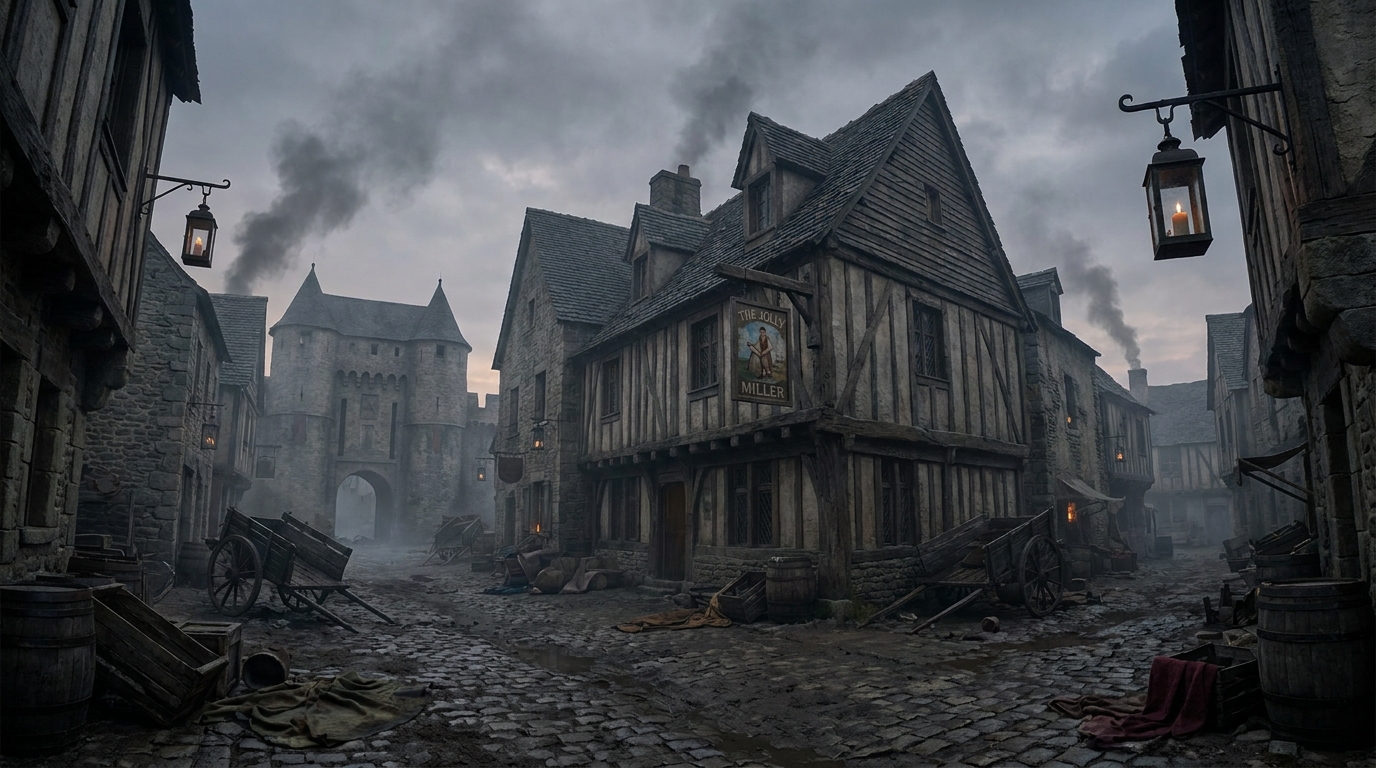
Meung
Synthesis
A market town where the author of the Romance of the Rose was born. It appeared to be in a state of revolution, with citizens rushing toward the hostelry of the Jolly Miller. The town has a High Street, a gate of Beaugency, and a hostelry called the Jolly Miller.
❝ the market town of Meung, in which the author of _Romance of the Rose_ was born, appeared to be in as perfect a state of revolution as if the Huguenots had just made a second La Rochelle of it. ❞
❝ Many citizens, seeing the women flying toward the High Street, leaving their children crying at the open doors, hastened to don the cuirass, and supporting their somewhat uncertain courage with a musket or a partisan, directed their steps toward the hostelry of the Jolly Miller ❞
❝ the appearance of the aforesaid pony at Meung—which place he had entered about a quarter of an hour before, by the gate of Beaugency—produced an unfavorable feeling ❞
❝ The host drew back and burst into tears. ❞
❝ “Some wine!” said Athos, on perceiving the host. ❞
❝ “All my oil is lost!” ❞
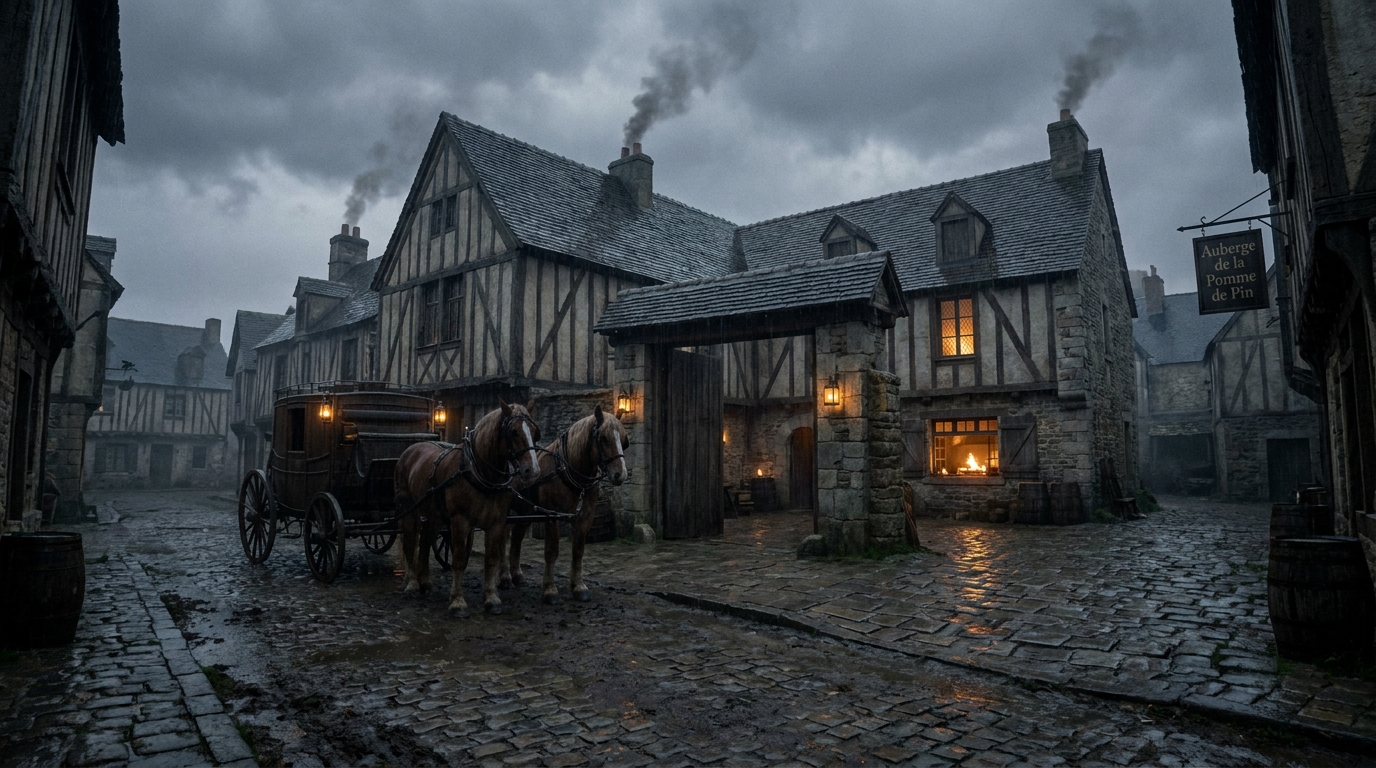
Hostelry of the Jolly Miller
Synthesis
An inn in Meung where D'Artagnan first encounters the stranger. It has a front gate, a kitchen, and a wife's chamber on the first floor. A heavy carriage drawn by two large Norman horses stands at the step.
❝ the hostelry of the Jolly Miller, before which was gathered, increasing every minute, a compact group, vociferous and full of curiosity. ❞
❝ he was alighting from his horse at the gate of the Jolly Miller, without anyone—host, waiter, or hostler—coming to hold his stirrup or take his horse ❞
❝ the host, with the help of his servants carried the wounded man into the kitchen ❞
❝ In my wife's chamber, on the first flight, where they are dressing his wounds. ❞
❝ the first thing he saw was his antagonist talking calmly at the step of a heavy carriage, drawn by two large Norman horses. ❞
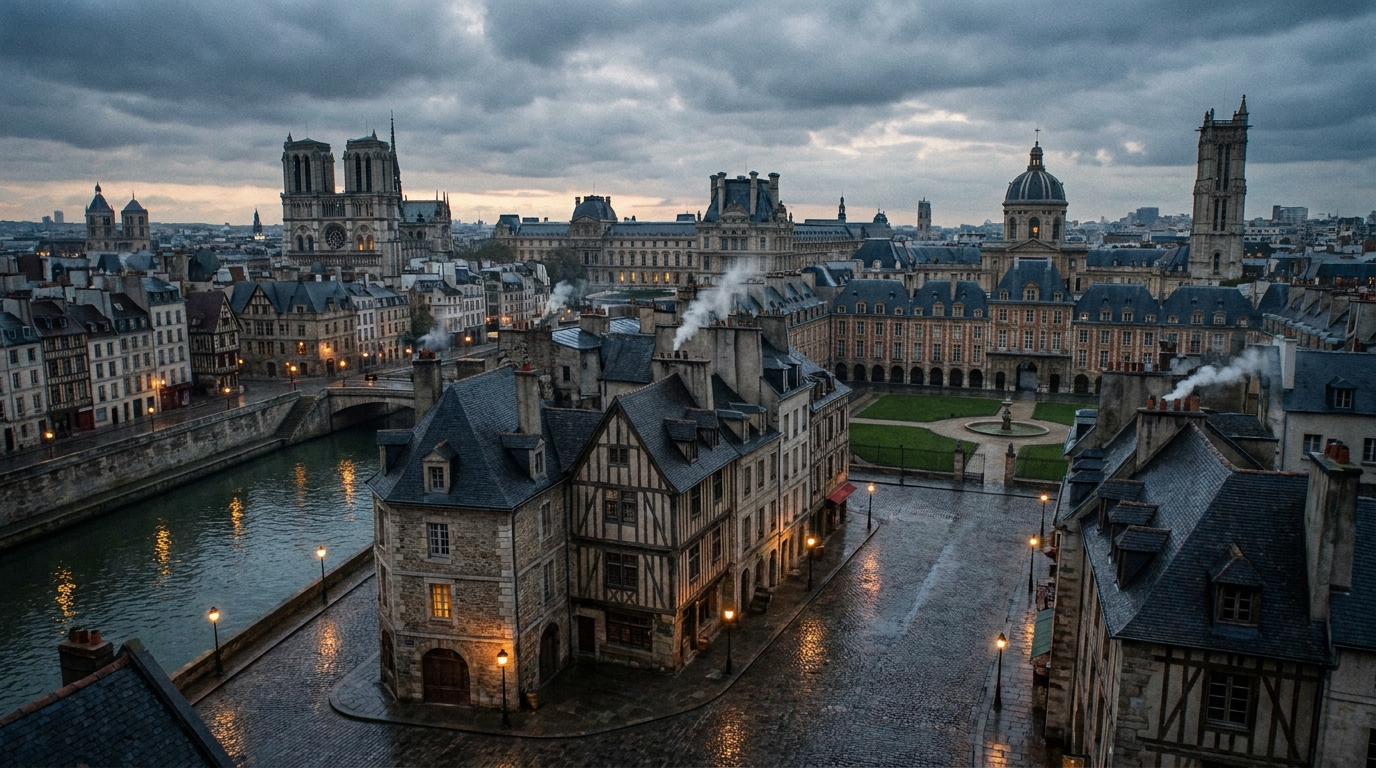
Paris
Synthesis
The main setting of the novel, including various streets, residences, and establishments. Key locations include the Rue Férou (Athos's residence), the Rue des Fossoyeurs (D'Artagnan's lodging), the Place Royale (Milady's hôtel), the Luxembourg gardens, and the church of St. Leu. The city is bustling with activity, with narrow streets, inns, and the royal palace.
❝ D'Artagnan entered Paris on foot, carrying his little packet under his arm, and walked about till he found an apartment to be let on terms suited to the scantiness of his means. ❞
❝ This chamber was a sort of garret, situated in the Rue des Fossoyeurs, near the Luxembourg. ❞
❝ Next he went to the Quai de Feraille to have a new blade put to his sword, and then returned toward the Louvre ❞
❝ the hôtel of M. de Tréville, which proved to be in the Rue du Vieux-Colombier; that is to say, in the immediate vicinity of the chamber hired by D'Artagnan ❞
❝ the Rue de Seine, and the Red Cross ❞
❝ D’Artagnan returned to the Rue Férou. ❞
❝ He went straight to the residence of Athos. ❞
❝ They went with their four lackeys to a spot behind the Luxembourg given up to the feeding of goats. ❞
❝ She lived in the Place Royale—then the fashionable quarter—at Number 6. ❞
❝ Porthos took his way toward the Rue aux Ours. ❞
❝ The approach was not such as to prepossess people—an ill-smelling, dark passage, a staircase half-lighted by bars through which stole a glimmer from a neighboring yard; on the first floor a low door studded with enormous nails, like the principal gate of the Grand Châtelet. ❞
❝ D’Artagnan perceived him one day walking toward the church of St. Leu. ❞
❝ They arrived at Crèvecœur. ❞
❝ the Louvre ❞
❝ the Rue des Fossoyeurs ❞
❝ the Faubourg St. Jacques, under verdant arches ❞
❝ the king made his entrance into Paris on the twenty-third of December of the same year ❞
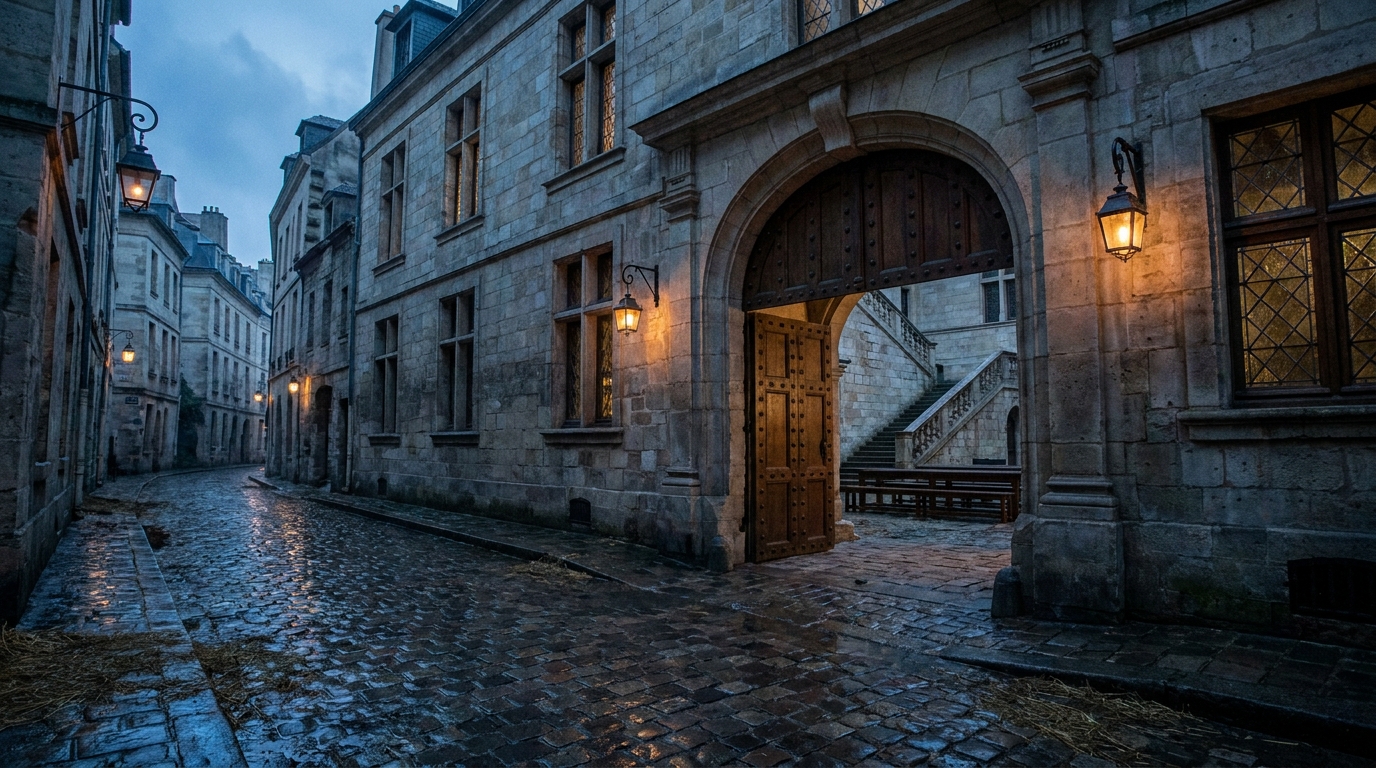
Hôtel of M. de Tréville
Synthesis
The residence of the captain of the Musketeers, located in the Rue du Vieux-Colombier. It has a court resembling a camp, an immense staircase, an antechamber with long circular benches, and a cabinet (office) contiguous to the antechamber. The door is massive and covered with long square-headed nails.
❝ The court of his hôtel, situated in the Rue du Vieux-Colombier, resembled a camp from by six o'clock in the morning in summer and eight o'clock in winter. ❞
❝ On one of those immense staircases, upon whose space modern civilization would build a whole house, ascended and descended the office seekers of Paris ❞
❝ In the antechamber, upon long circular benches, reposed the elect; that is to say, those who were called. ❞
❝ M. de Tréville, in his office contiguous to this antechamber, received visits ❞
❝ the massive door covered with long square-headed nails ❞
❝ the cabinet of M. de Tréville, generally held so sacred ❞
❝ the embrasure of the window, where they had talked together ❞
❝ he seated himself at a table in order to write the promised letter of recommendation ❞
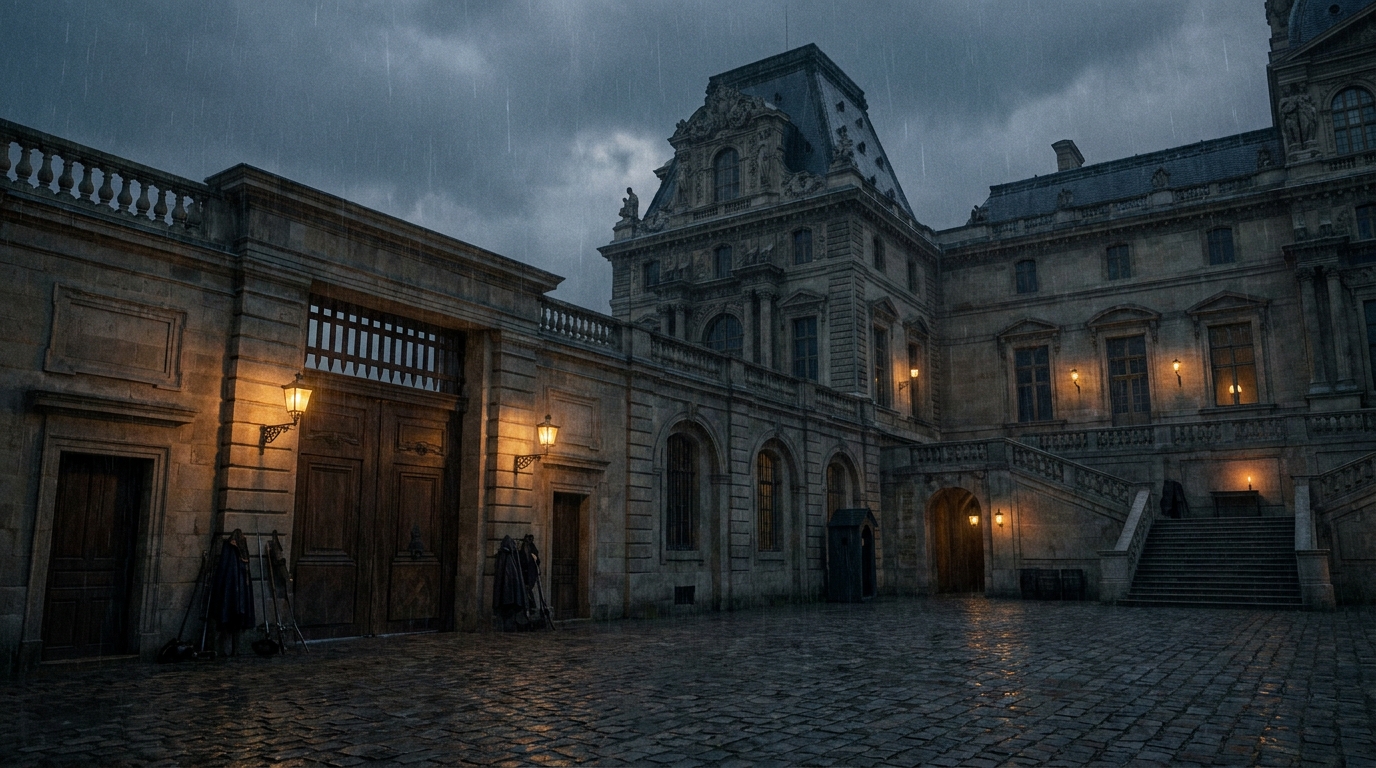
Louvre
Synthesis
The royal palace in Paris. It contains the queen's apartments, a wicket gate (the Echelle), a servants' door, dark corridors, a staircase, a long corridor, and a room lit by a lamp. The king's apartments are connected by a corridor to the queen's. The palace is guarded by Musketeers.
❝ like the king in his balcony at the Louvre ❞
❝ I will go straight to the Louvre; I will give in my resignation as captain of the king's Musketeers ❞
❝ In the evening M. de Tréville attended the king's gaming table. ❞
❝ Then turning toward M. de Tréville and walking with him toward the embrasure of a window, 'Well, monsieur,' continued he, 'you say it is his Eminence's Guards who have sought a quarrel with your Musketeers?' ❞
❝ Our young men had been waiting about half an hour, amid a crowd of courtiers, when all the doors were thrown open, and his Majesty was announced. ❞
❝ Louis XIII. appeared, walking fast. He was in hunting costume covered with dust, wearing large boots, and holding a whip in his hand. ❞
❝ M. de Tréville entered the king's cabinet boldly, and found his Majesty in a very ill humor, seated on an armchair, beating his boot with the handle of his whip. ❞
❝ On arriving at the king's private antechamber, M. de Tréville found La Chesnaye, who informed him that they had not been able to find M. de la Trémouille on the preceding evening at his hôtel, that he returned too late to present himself at the Louvre, that he had only that moment arrived and that he was at that very hour with the king. ❞
❝ Present yourself at the wicket of the Louvre, on the side of the Rue de l'Echelle, and ask for Germain. ❞
❝ In two bounds he was at the Louvre; as he entered the wicket of L'Echelle, ten o'clock struck. ❞
❝ His company was on guard at the Louvre; he was at the Louvre with his company. ❞
❝ the young woman and the handsome Musketeer entered the Louvre by the wicket of the Echelle without any interference. ❞
❝ Once within the interior of the court, the duke and the young woman followed the wall for the space of about twenty-five steps. ❞
❝ Mme. Bonacieux pushed a little servants’ door, open by day but generally closed at night. ❞
❝ Both entered, and found themselves in darkness; but Mme. Bonacieux was acquainted with all the turnings and windings of this part of the Louvre, appropriated for the people of the household. ❞
❝ She closed the door after her, took the duke by the hand, and after a few experimental steps, grasped a balustrade, put her foot upon the bottom step, and began to ascend the staircase. ❞
❝ The duke counted two stories. She then turned to the right, followed the course of a long corridor, descended a flight, went a few steps farther, introduced a key into a lock, opened a door, and pushed the duke into an apartment lighted only by a lamp. ❞
❝ At this moment a door concealed in the tapestry opened, and a woman appeared. ❞
❝ the queen's apartment ❞
❝ the door of the queen's chamber opened ❞
❝ the king opened the door of communication, and passed into the corridor which led from his apartments to those of Anne of Austria. ❞
❝ the queen's apartments ❞
❝ The queen ran to a little table, on which were ink, paper, and pens. ❞
❝ The queen had just regained her chamber, and D’Artagnan was about to retire, when he felt his shoulder lightly touched. ❞
❝ He found himself in a closet attached to the queen’s apartment. ❞
CA
Carmes-Deschaux (Convent of the Carmes Déchaussés)
Synthesis
A convent near the Preaux-Clercs, used as a dueling ground. It is a sort of building without a window, surrounded by barren fields. The spot is bare and exposed to the sun.
❝ Near the Carmes-Deschaux. ❞
❝ the convent of the Carmes Déchaussés, or rather Deschaux, as it was called at that period, a sort of building without a window, surrounded by barren fields—an accessory to the Preaux-Clercs ❞
❝ the bare spot of ground which extended along the foot of the monastery ❞
LU
Luxembourg
Synthesis
A park in Paris, behind which is a spot given up to the feeding of goats. It is used as the location for the duel between the four friends and the Englishmen.
❝ behind the Luxembourg ❞
❝ Aramis ascending the street which led to the Luxembourg ❞
❝ They went with their four lackeys to a spot behind the Luxembourg given up to the feeding of goats. ❞
HÔ
Hôtel d'Arguillon
Synthesis
A building in Paris, opposite which Aramis and D'Artagnan have a confrontation. It is full of the cardinal's creatures.
❝ the hôtel d'Arguillon ❞
❝ we are opposite the Hôtel d'Arguillon, which is full of the cardinal's creatures ❞
RU
Rue Férou
Synthesis
A street in Paris where Athos resides. The residence is a modest apartment, likely on an upper floor, with a door that can be bolted. The room contains a table and chairs, and is used for meetings of the four friends.
❝ a riot in the Rue Férou in a cabaret ❞
❝ D’Artagnan returned to the Rue Férou. ❞
❝ He found Athos and Aramis philosophizing. ❞
❝ The two friends repaired to Athos’s, and he, faithful to his vow of not going out, took upon him to order dinner to be brought to them. ❞
GA
Gate St. Honoré
Synthesis
A city gate in Paris, mentioned as a meeting place.
❝ near the gate St. Honoré ❞
GA
Gate of St. Antoine
Synthesis
A city gate in Paris through which D'Artagnan enters the city.
❝ the gate of St. Antoine at Paris ❞
QU
Quai de Feraille
Synthesis
A quay in Paris where D'Artagnan goes to have a new blade put to his sword.
❝ Next he went to the Quai de Feraille to have a new blade put to his sword ❞
RU
Rue des Fossoyeurs
Synthesis
A street in Paris where the Bonacieux residence is located. The house has a street door, an interior door leading to a passage, and stairs to D'Artagnan's chambers. The mercer's house has a bad name.
❝ This chamber was a sort of garret, situated in the Rue des Fossoyeurs, near the Luxembourg. ❞
❝ Five minutes later he was in the Rue des Fossoyeurs. ❞
❝ he had entered the alley, at the end of which were the stairs which led to his chamber. ❞
❝ Here it would be dangerous; the house may be watched. ❞
❝ Bonacieux called a long time; but as such cries, on account of their frequency, brought nobody in the Rue des Fossoyeurs, and as lately the mercer’s house had a bad name, finding that nobody came, he went out continuing to call, his voice being heard fainter and fainter as he went in the direction of the Rue du Bac. ❞
❝ She found M. Bonacieux alone; the poor man was recovering with difficulty the order in his house, in which he had found most of the furniture broken and the closets nearly emptied. ❞
❝ D’Artagnan drew back the bolt with precaution, and both, light as shadows, glided through the interior door into the passage, ascended the stairs as quietly as possible, and entered D’Artagnan’s chambers. ❞
❝ What, the mercer’s wife of the Rue des Fossoyeurs? ❞
❝ You must return to the Rue des Fossoyeurs; I will accompany you. ❞
❝ They arrived without accident at the Rue des Fossoyeurs. Bonacieux was standing at the door ❞
❝ Upon the landing leading to the chamber, and crouching against the door, he found the poor girl ❞
RU
Rue du Vieux-Colombier
Synthesis
A street in Paris where the hôtel of M. de Tréville is located.
❝ the hôtel of M. de Tréville, which proved to be in the Rue du Vieux-Colombier ❞
RU
Rue de Seine
Synthesis
A street in Paris, mentioned as part of D'Artagnan's search for the stranger.
❝ went down to the ferry, came up again by the Rue de Seine ❞
RE
Red Cross
Synthesis
A location in Paris, mentioned as part of D'Artagnan's search.
❝ the Red Cross ❞
RU
Rue Vaugirard
Synthesis
A street in Paris, at the end of which Porthos appears.
❝ at the end of the Rue Vaugirard the gigantic Porthos appeared ❞
HÔ
Hôtel de M. de Tréville
Synthesis
The residence and headquarters of the Captain of the Musketeers. It is a large building, always full of Musketeers and soldiers. It has a gateway, a saloon, and a private office where M. de Tréville receives visitors. The atmosphere is lively and bustling, with many soldiers coming and going.
❝ They walked arm in arm, occupying the whole width of the street and taking in every Musketeer they met, so that in the end it became a triumphal march. ❞
❝ As usual, this hôtel was full of soldiers of this company, who hastened to the succor of their comrades. ❞
❝ M. de Tréville recommended everyone to return home and wait for news. ❞
❝ Instead of going into the saloon with the rest of the crowd, he asked to be introduced to M. de Tréville's office. ❞
CO
Convent des Carmes (Carmes-Deschaux)
Synthesis
A convent near which the initial fight between the Musketeers and the Cardinal's Guards takes place. It is a deserted area, with a convent wall and a porch. The location is described as a deserted place suitable for a duel.
❝ and springing backward, he broke his sword across his knee to avoid the necessity of surrendering it, threw the pieces over the convent wall, and crossed his arms, whistling a cardinalist air. ❞
❝ Then, assisted by Bicarat, the only one left standing, they bore Jussac, Cahusac, and one of Aramis's adversaries who was only wounded, under the porch of the convent. ❞
❝ I leave your Majesty to judge what five armed men could possibly be going to do in such a deserted place as the neighborhood of the Convent des Carmes. ❞
TE
Tennis court near the Luxembourg
Synthesis
A tennis court situated near the stables of the Luxembourg. It has a gallery and a cord. Spectators watch the game. The street outside is empty at times.
❝ he had made a party with Porthos and Aramis to play a game at tennis in a tennis court situated near the stables of the Luxembourg. ❞
❝ he went and took his place near the cord and in the gallery. ❞
❝ seeing that the street was empty, said to his adversary, 'My faith! It is fortunate for you, although your name is Bernajoux, to have only to deal with an apprentice Musketeer.' ❞
HÔ
Hôtel de la Trémouille
Synthesis
The residence of the Duc de la Trémouille. It has gates, and is described as a nest of Huguenots. The hôtel is attacked by the Musketeers, who hurl paving stones at the gates.
❝ they even began to deliberate whether they should not set fire to the hôtel to punish the insolence of M. de la Trémouille's domestics in daring to make a sortie upon the king's Musketeers. ❞
❝ they contented themselves with hurling some paving stones against the gates; but the gates were too strong. ❞
❝ which would not, perhaps, have been a great misfortune in time of war, seeing that it is nothing but a nest of Huguenots ❞
RU
Rue Férou (Athos's lodging)
Synthesis
A street within two steps of the Luxembourg. Athos's apartment consists of two small chambers, nicely fitted up, in a furnished house. The walls have fragments of past splendor: a richly embossed sword from the times of Francis I, a portrait of a nobleman, and a casket of magnificent goldwork on the mantelpiece.
❝ Athos dwelt in the Rue Férou, within two steps of the Luxembourg. His apartment consisted of two small chambers, very nicely fitted up, in a furnished house, the hostess of which, still young and still really handsome, cast tender glances uselessly at him. ❞
❝ Some fragments of past splendor appeared here and there upon the walls of this modest lodging; a sword, for example, richly embossed, which belonged by its make to the times of Francis I, the hilt of which alone, encrusted with precious stones, might be worth two hundred pistoles ❞
❝ in addition to the sword, there was a portrait representing a nobleman of the time of Henry III., dressed with the greatest elegance, and who wore the Order of the Holy Ghost ❞
❝ a casket of magnificent goldwork, with the same arms as the sword and the portrait, formed a middle ornament to the mantelpiece ❞
RU
Rue du Vieux-Colombier (Porthos's lodging)
Synthesis
Porthos lives in an apartment large in size and of very sumptuous appearance. One of the windows is often occupied by Mousqueton in full livery.
❝ Porthos lived in an apartment, large in size and of very sumptuous appearance, in the Rue du Vieux-Colombier. ❞
❝ Every time he passed with a friend before his windows, at one of which Mousqueton was sure to be placed in full livery, Porthos raised his head and his hand, and said, 'That is my abode!' ❞
AR
Aramis's lodging
Synthesis
A little lodging composed of a boudoir, an eating room, and a bedroom, all on the ground floor. It looks out upon a little fresh green garden, shady and impenetrable to the eyes of neighbors. The house is between the Rue Cassette and the Rue Servandoni, with a door shaded by sycamores and clematis.
❝ Aramis, he dwelt in a little lodging composed of a boudoir, an eating room, and a bedroom, which room, situated, as the others were, on the ground floor, looked out upon a little fresh green garden, shady and impenetrable to the eyes of his neighbors. ❞
❝ The house in which Aramis dwelt was situated between the Rue Cassette and the Rue Servandoni. ❞
❝ he already perceived the door of his friend's house, shaded by a mass of sycamores and clematis which formed a vast arch opposite the front of it ❞
RU
Rue des Fossoyeurs (D'Artagnan's lodging)
Synthesis
D'Artagnan's apartment, consisting of an antechamber and a bedroom. The bedroom has a window facing the street. The floor has a removable plank through which D'Artagnan can observe the room below. The building is owned by M. Bonacieux.
❝ The bed was the only one in the apartment, which consisted of an antechamber and a bedroom. ❞
❝ Planchet slept in the antechamber upon a coverlet taken from the bed of D'Artagnan ❞
❝ He converted his chamber into an observatory. From his windows he saw all the visitors who were caught. ❞
❝ Then, having removed a plank from his floor, and nothing remaining but a simple ceiling between him and the room beneath, in which the interrogatories were made, he heard all that passed between the inquisitors and the accused. ❞
PL
Place St. Sulpice
Synthesis
A square in Paris where D'Artagnan and Mme. Bonacieux stop after fleeing. It is a public space, likely with a fountain or statue.
❝ did not stop till they came to the Place St. Sulpice. ❞
FO
Forest of St. Germain
Synthesis
A forest where the king goes stag hunting. It is described as having game, and the hunt lasts for hours.
❝ the king had gone stag hunting in the forest of St. Germain. ❞
❝ We started a stag of ten branches. We chased him for six hours, and when he was near being taken—when St. Simon was already putting his horn to his mouth to sound the halali—crack, all the pack takes the wrong scent and sets off after a two-year-older. ❞
PO
Pomme-de-Pin
Synthesis
A cabaret (tavern) in Paris where D'Artagnan and his friends meet. It is a place to wait and discuss plans.
❝ Athos advised him to order a good repast at the Pomme-de-Pin ❞
❝ Let them wait for me at the Pomme-de-Pin. ❞
❝ As for D’Artagnan, he immediately repaired to the cabaret of the Pomme-de-Pin, where he found Porthos and Aramis awaiting him. ❞
BR
Bridge Tournelle
Synthesis
A bridge in Paris where Porthos finds Planchet making rings and plashing in the water.
❝ He was a Picard, whom the glorious Musketeer had picked up on the Bridge Tournelle, making rings and plashing in the water. ❞
RU
Rue de l'Echelle (Louvre wicket)
Synthesis
A side entrance to the Louvre, a wicket gate where Germain is the concierge.
❝ Present yourself at the wicket of the Louvre, on the side of the Rue de l'Echelle, and ask for Germain. ❞
RU
Rue Cherish-Midi (Chase-Midi)
Synthesis
A street in Paris, in the quarter where Aramis lives. D'Artagnan walks there at night.
❝ D'Artagnan, reflecting on his future amours, addressing himself to the beautiful night, and smiling at the stars, ascended the Rue Cherish-Midi, or Chase-Midi, as it was then called. ❞
RU
Rue d'Assas (lane)
Synthesis
A lane in Paris, where D'Artagnan walks at night, breathing the balmy emanations from the Rue de Vaugirard.
❝ D'Artagnan was passing along a lane on the spot where the Rue d'Assas is now situated, breathing the balmy emanations which were borne upon the wind from the Rue de Vaugirard, and which arose from the gardens refreshed by the dews of evening and the breeze of night. ❞
RU
Rue de Vaugirard
Synthesis
A street in Paris where a house (No. 25) is located. It is associated with the Duchesse de Chevreuse and the Duke of Buckingham. The house has a shutter that can be knocked upon.
❝ Arriving there, the young woman seemed to hesitate, as she had before done in the Rue Vaugirard. ❞
❝ No. 25 in the Rue de Vaugirard ❞
❝ one in the Rue de Vaugirard, No. 25 ❞
❝ the woman had the outline of Mme. Bonacieux; the man resembled Aramis so much as to be mistaken for him. ❞
❝ he ran without stopping from the Rue Férou to the Rue de Vaugirard. ❞
❝ Aramis, taking a small key from his breast and opening a little ebony box inlaid with mother of pearl ❞
RU
Rue de la Harpe
Synthesis
A street in Paris where a house (No. 75) is located. It is near the Luxembourg. The Duke of Buckingham lodged there.
❝ both gained the top of Rue de la Harpe. ❞
❝ No. 75 in the Rue de la Harpe ❞
❝ the other in the Rue de la Harpe, No. 75 ❞
❝ Where did he lodge? Rue de la Harpe. No. 75. ❞
BA
Bastille
Synthesis
A fortress and prison in Paris. It has a half-subterranean gallery, a court, a corridor with sentinels, a low room with a table and chair for interrogation, and dungeons. Prisoners are led through various courts and corridors.
❝ The officers who arrested him conducted him straight to the Bastille, where he passed trembling before a party of soldiers who were loading their muskets. ❞
❝ Thence, introduced into a half-subterranean gallery, he became, on the part of those who had brought him, the object of the grossest insults and the harshest treatment. ❞
❝ Two guards attended the mercer who made him traverse a court and enter a corridor in which were three sentinels, opened a door and pushed him unceremoniously into a low room, where the only furniture was a table, a chair, and a commissary. ❞
❝ Where must we place him? In a dungeon. ❞
❝ the same dungeon where he had passed the night ❞
❝ He passed along the same corridor as before, crossed one court, then a second side of a building; at length, at the gate of the entrance court he found a carriage surrounded by four guards on horseback. ❞
HÔ
Hôtel de Tréville
Synthesis
The residence of Monsieur de Tréville, captain of the Musketeers. It contains a saloon where his habitual court of gentlemen gather, and a private office where he receives D'Artagnan.
❝ M. de Tréville was not at his hôtel. ❞
❝ did me the honor after having dined with me to be conversing in the saloon of my hôtel, with the Duc de la Trémouille and the Comte de Châlus, who happened to be there. ❞
❝ D'Artagnan directed his course toward M. de Tréville’s. ❞
❝ M. de Tréville was in his saloon with his habitual court of gentlemen. ❞
❝ D’Artagnan, who was known as a familiar of the house, went straight to his office, and sent word that he wished to see him on something of importance. ❞
NE
New Bridge
Synthesis
A bridge in Paris crossing the Seine. D'Artagnan plans to cross it to reach the Louvre.
❝ He therefore went down the Rue des Petits Augustins, and came up to the quay, in order to take the New Bridge. ❞
SA
Samaritaine
Synthesis
A location on the bridge, illuminated by a lamp. D'Artagnan confronts the Duke of Buckingham and Mme. Bonacieux there.
❝ He passed them, then returned so as to meet them exactly before the Samaritaine, which was illuminated by a lamp which threw its light over all that part of the bridge. ❞
FO
Fort l'Evêque
Synthesis
A prison in Paris where Athos is held. It has solitary confinement in a dungeon.
❝ Athos was then lodged in Fort l’Evêque. ❞
❝ Yes, sire, in solitary confinement, in a dungeon, like the lowest criminal. ❞
CA
Cabinet of the Cardinal
Synthesis
A large, close, stifling room with walls furnished with arms, a square table covered with books and papers, and a map of La Rochelle. There is a fire burning. The cardinal stands before the chimney.
❝ It was a large cabinet, close and stifling, with the walls furnished with arms offensive and defensive, and in which there was already a fire, although it was scarcely the end of the month of September. ❞
❝ A square table, covered with books and papers, upon which was unrolled an immense plan of the city of La Rochelle, occupied the center of the room. ❞
❝ Standing before the chimney was a man of middle height, of a haughty, proud mien; with piercing eyes, a large brow, and a thin face, which was made still longer by a royal (or imperial, as it is now called), surmounted by a pair of mustaches. ❞
HÔ
Hôtel de Ville
Synthesis
The city hall of Paris, where the ballet of La Merlaison takes place. It has a grand saloon with platforms for guests, a little room on the side of the church of St. Jean with a silver buffet, and chambers for dressing. The building is guarded by archers and Swiss guards.
❝ there will shortly be a ball at the Hôtel de Ville. ❞
❝ The aldermen of the city give a fête on the third of October. ❞
❝ Eight days had been occupied in preparations at the Hôtel de Ville for this important evening. ❞
❝ The city carpenters had erected scaffolds upon which the invited ladies were to be placed; the city grocer had ornamented the chambers with two hundred flambeaux of white wax ❞
❝ As fast as they entered, they were placed in the grand saloon, on the platforms prepared for them. ❞
❝ the king’s collation, consisting of preserves and other delicacies, was prepared in the little room on the side of the church of St. Jean, in front of the silver buffet of the city ❞
❝ A private room had been prepared for the king and another for Monsieur. In each of these closets were placed masquerade dresses. ❞
RU
Rue des Petits Augustins
Synthesis
A street in Paris that D'Artagnan takes to reach the quay.
❝ He therefore went down the Rue des Petits Augustins, and came up to the quay, in order to take the New Bridge. ❞
RU
Rue Guénegaud
Synthesis
A street in Paris where D'Artagnan sees two persons coming out of the Rue Dauphine.
❝ As he gained the top of the Rue Guénegaud, he saw two persons coming out of the Rue Dauphine whose appearance very much struck him. ❞
RU
Rue Dauphine
Synthesis
A street in Paris from which two persons emerge.
❝ he saw two persons coming out of the Rue Dauphine ❞
ST
St. Paul
Synthesis
A location in Paris where those condemned at the Bastille were executed. Bonacieux fears it.
❝ At the moment of arriving at St. Paul—the spot where such as were condemned at the Bastille were executed—he was near fainting and crossed himself twice. ❞
CE
Cemetery of St. Jean
Synthesis
A cemetery where state criminals were buried. Bonacieux passes by it.
❝ a still greater terror seized him on passing by the cemetery of St. Jean, where state criminals were buried. ❞
LA
La Grêve
Synthesis
A place of execution in Paris. Bonacieux fears it.
❝ when he saw the carriage take the way to La Grêve, when he perceived the pointed roof of the Hôtel de Ville, and the carriage passed under the arcade, he believed it was over with him. ❞
TR
Traitor's Cross
Synthesis
A place where lesser criminals were executed. Bonacieux fears it.
❝ it was at the Traitor’s Cross that lesser criminals were executed. ❞
RU
Rue St. Honoré
Synthesis
A street in Paris through which the carriage passes.
❝ The carriage... threaded the Rue St. Honoré ❞
RU
Rue des Bons Enfants
Synthesis
A street in Paris where the carriage stops before a low door.
❝ turned into the Rue des Bons Enfants, and stopped before a low door. ❞
AN
Antechamber of the Cardinal's residence
Synthesis
A room with a bench covered with a well-stuffed cushion, walls ornamented with Cordova leather, and large red damask curtains fastened back by gold clasps.
❝ the bench was comfortably covered with a well-stuffed cushion, as the wall was ornamented with a beautiful Cordova leather, and as large red damask curtains, fastened back by gold clasps, floated before the window ❞
CH
Chantilly
Synthesis
A town where the travelers stop for breakfast at an inn with a sign representing St. Martin giving half his cloak to a poor man. The inn has a common hall where a stranger is seated at the same table.
❝ All went well till they arrived at Chantilly, which they reached about eight o’clock in the morning. They needed breakfast, and alighted at the door of an auberge, recommended by a sign representing St. Martin giving half his cloak to a poor man. ❞
❝ They entered the common hall, and placed themselves at table. A gentleman, who had just arrived by the route of Dammartin, was seated at the same table, and was breakfasting. ❞
❝ I was near dying of my wounds at first, and of hunger afterward, in a beggarly inn at Chantilly. ❞
❝ “Some wine!” said Athos, on perceiving the host. ❞
BE
Beauvais
Synthesis
A town where the travelers stop for two hours to rest their horses and wait for Porthos. The road beyond Beauvais is confined between two high banks and unpaved, with ruts.
❝ At Beauvais they stopped two hours, as well to breathe their horses a little as to wait for Porthos. ❞
❝ At a league from Beauvais, where the road was confined between two high banks, they fell in with eight or ten men who, taking advantage of the road being unpaved in this spot, appeared to be employed in digging holes and filling up the ruts with mud. ❞
CR
Crèvecœur
Synthesis
An inn where Aramis is staying when D'Artagnan and Athos arrive. Aramis is seen sitting at a window, looking out at the dust in the horizon.
❝ but at Crèvecœur, Aramis declared he could proceed no farther. In fact, it required all the courage which he concealed beneath his elegant form and polished manners to bear him so far. He grew more pale every minute, and they were obliged to support him on his horse. They lifted him off at the door of a cabaret, left Bazin with him ❞
❝ From a distance they perceived Aramis, seated in a melancholy manner at his window, looking out, like Sister Anne, at the dust in the horizon. ❞
AM
Amiens
Synthesis
A city where the travelers arrive at midnight and alight at the auberge of the Golden Lily. The inn has charming chambers at opposite extremities, a common chamber, a yard, and stables. The host appears honest but is later revealed to be treacherous.
❝ They arrived at Amiens at midnight, and alighted at the auberge of the Golden Lily. ❞
❝ The host had the appearance of as honest a man as any on earth. He received the travelers with his candlestick in one hand and his cotton nightcap in the other. ❞
❝ The host was alone, seated before his desk, one of the drawers of which was partly open. ❞
❝ A market cart, which some minutes before had appeared upon the Amiens road, pulled up at the inn. ❞
CA
Calais
Synthesis
A port city in France. The governor's country house is a quarter of a league from the city, at the foot of a little hill with a slated roof. There is a wood outside the city, and a quay where vessels are moored.
❝ At a hundred paces from the gates of Calais, D’Artagnan’s horse gave out ❞
❝ They left their two nags upon the high road, and ran toward the quay. ❞
❝ The governor's country house is at a quarter of a league from the city. Look, you may see it from here—at the foot of that little hill, that slated roof. ❞
BU
Buckingham's hôtel in London
Synthesis
The Duke of Buckingham's residence in London. It has a court, vestibule, several elegantly furnished apartments, a bedchamber with a tapestry-hidden door, and a small chapel covered with Persian silk tapestry worked with gold, brilliantly lit with candles. The chapel contains an altar with a canopy of blue velvet surmounted by white and red plumes, and a full-length portrait of Anne of Austria.
❝ On entering the court of his hôtel, Buckingham sprang from his horse, and without thinking what became of the animal, threw the bridle on his neck, and sprang toward the vestibule. ❞
❝ He passed through several apartments, of an elegance of which even the greatest nobles of France had not even an idea, and arrived at length in a bedchamber which was at once a miracle of taste and of richness. ❞
❝ In the alcove of this chamber was a door concealed in the tapestry which the duke opened with a little gold key which he wore suspended from his neck by a chain of the same metal. ❞
❝ The two found themselves in a small chapel covered with a tapestry of Persian silk worked with gold, and brilliantly lighted with a vast number of candles. Over a species of altar, and beneath a canopy of blue velvet, surmounted by white and red plumes, was a full-length portrait of Anne of Austria ❞
ST
St. Cloud
Synthesis
A location outside Paris where D'Artagnan is to meet Mme. Bonacieux. The rendezvous is in front of the pavilion at the corner of the house of M. d'Estrées.
❝ Be this evening about ten o’clock at St. Cloud, in front of the pavilion which stands at the corner of the house of M. d’Estrées. ❞
TH
The Pavilion of the D'Estrées
Synthesis
A small pavilion situated at the angle of a high wall in a very private spot in St. Cloud. The wall runs along one side of a retired lane; on the other side is a little garden connected with a poor cottage protected by a hedge. The pavilion has windows closed with shutters, except one on the first story through which shines a mild light that silvered the foliage of two or three linden trees outside the park. Inside, the room has gilded moldings on the ceiling. During the abduction, the chamber is in fearful disorder: a window broken, the door beaten in and hanging split on its hinges, a table overturned, decanters broken, fruits crushed, fragments of garments and bloody spots on the cloth and curtains. The ground outside is trampled and hoofmarked, with deep carriage wheel impressions coming from Paris and turning back.
❝ It was situated in a very private spot. A high wall, at the angle of which was the pavilion, ran along one side of this lane, and on the other was a little garden connected with a poor cottage which was protected by a hedge from passers-by. ❞
❝ Through this window shone a mild light which silvered the foliage of two or three linden trees which formed a group outside the park. ❞
❝ his eyes fixed upon that charming little abode of which he could perceive a part of the ceiling with its gilded moldings, attesting the elegance of the rest of the apartment. ❞
❝ to find that this soft light, this calm lamp, enlightened a scene of fearful disorder. One of the windows was broken, the door of the chamber had been beaten in and hung, split in two, on its hinges. A table, which had been covered with an elegant supper, was overturned. The decanters broken in pieces, and the fruits crushed, strewed the floor. Everything in the apartment gave evidence of a violent and desperate struggle. ❞
❝ he perceived a thing that he had not before remarked—that the ground, trampled here and hoofmarked there, presented confused traces of men and horses. Besides, the wheels of a carriage, which appeared to have come from Paris, had made a deep impression in the soft earth, which did not extend beyond the pavilion, but turned again toward Paris. ❞
❝ The lane was still deserted, and the same calm soft light shone through the window. ❞
❝ the three men brought the carriage up quietly, and took out of it a little man, stout, short, elderly, and commonly dressed in clothes of a dark color, who ascended the ladder very carefully, looked suspiciously in at the window of the pavilion, came down as quietly as he had gone up, and whispered, 'It is she!' ❞
❝ All at once great cries resounded in the pavilion, and a woman came to the window, and opened it, as if to throw herself out of it; but as soon as she perceived the other two men, she fell back and they went into the chamber. ❞
TH
The Inn at Chantilly (Great St. Martin)
Synthesis
A tavern in Chantilly where the travelers stop. It has a small room for those who wish to be alone. The inn has a cellar with a ventilating hole, and the host keeps the key. The best chamber is on the first story, number one, with a large chimneypiece, a wardrobe, and a commode. The room has a fire, and a spit loaded with partridges turns before it. There are chafing dishes with stewpans. The top of the wardrobe and the marble of the commode are covered with empty bottles.
❝ entered a small room destined to receive those who wished to be alone ❞
❝ Porthos was in bed, and was playing a game at lansquenet with Mousqueton, to keep his hand in; while a spit loaded with partridges was turning before the fire, and on each side of a large chimneypiece, over two chafing dishes, were boiling two stewpans, from which exhaled a double odor of rabbit and fish stews, rejoicing to the smell. In addition to this he perceived that the top of a wardrobe and the marble of a commode were covered with empty bottles. ❞
❝ the handsomest in the inn—a chamber that I could have let ten times over. ❞
❝ our host has a well-furnished cellar the key of which never leaves him; only this cellar has a ventilating hole. ❞
❝ the best chamber in the hôtel ❞
TH
The Inn at Crèvecœur
Synthesis
A cabaret in the village of Crèvecœur where Aramis was left wounded. It has an exterior staircase in the courtyard leading to the second floor. The chamber of Aramis is number five on the second floor. The room is furnished with an oblong table covered with rolls of paper and enormous folio volumes. The curtains are half drawn, admitting a mysterious light. Mundane objects like sword, pistols, plumed hat, and laces have been removed; in an obscure corner hangs a discipline cord from a nail.
❝ found one of those exterior staircases that are still to be seen in the yards of our old-fashioned taverns. ❞
❝ Aramis, in a black gown, his head enveloped in a sort of round flat cap, not much unlike a calotte, was seated before an oblong table, covered with rolls of paper and enormous volumes in folio. ❞
❝ The curtains were half drawn, and only admitted the mysterious light calculated for beatific reveries. ❞
❝ All the mundane objects that generally strike the eye on entering the room of a young man, particularly when that young man is a Musketeer, had disappeared as if by enchantment; and for fear, no doubt, that the sight of them might bring his master back to ideas of this world, Bazin had laid his hands upon sword, pistols, plumed hat, and embroideries and laces of all kinds and sorts. ❞
❝ In their stead D'Artagnan thought he perceived in an obscure corner a discipline cord suspended from a nail in the wall. ❞
TH
The Inn at Amiens
Synthesis
A cursed inn where Athos was trapped. It has a cellar with a door at the bottom of stairs. The cellar contains wine in bottles and casks, beer, oil, spices, bacon, and sausages. The cellar door can be barricaded from inside. The inn has a public room and best apartments upstairs. The cellar is described as having fagots, planks, and empty casks heaped up as fortifications; puddles of oil and wine; bones and fragments of hams; a heap of broken bottles; and a tun with a running cock.
❝ he found the door of the cellar stairs behind him, and as the door was open, he took out the key, and barricaded himself inside. ❞
❝ all our provisions are in the cellar. There is our wine in bottles, and our wine in casks; the beer, the oil, and the spices, the bacon, and sausages. ❞
❝ beyond the fortifications through which Athos had made a breach in order to get out, and which were composed of fagots, planks, and empty casks, heaped up according to all the rules of the strategic art, they found, swimming in puddles of oil and wine, the bones and fragments of all the hams they had eaten; while a heap of broken bottles filled the whole left-hand corner of the cellar, and a tun, the cock of which was left running, was yielding, by this means, the last drop of its blood. ❞
❝ the four crossed the public room and proceeded to take possession of the best apartment in the house ❞
❝ the cellar stairs ❞
❝ the door of the cellar ❞
TH
The Hôtel des Gardes
Synthesis
The stables of the Guards' hotel where the horses are kept. It has stables where horses are groomed. D'Artagnan meets Planchet there and later saddles his horse.
❝ As he passed the Hôtel des Gardes, he took a glance into the stables. ❞
❝ Ten minutes afterward Planchet joined him at the stables of the Hôtel des Gardes. ❞
TH
The Rue des Fossoyeurs (D'Artagnan's lodging)
Synthesis
The street where D'Artagnan lodges, with the house of M. Bonacieux. The building has a threshold and an upper apartment. The bed in Bonacieux's apartment is noted as unused.
❝ On approaching the house, he perceived M. Bonacieux in morning costume, standing at his threshold. ❞
❝ D'Artagnan went quickly into the house, and cast a rapid glance at the bed. It had not been used. ❞
TH
The Bois de Boulogne
Synthesis
A forest on the road to St. Cloud, with tall trees and dark underwood where moonlight reflects.
❝ the oscillation of the tall trees and the reflection of the moon in the dark underwood gave him serious uneasiness. ❞
TH
The Road to St. Cloud
Synthesis
The road leading from Paris to St. Cloud, passing through the Bois de Boulogne. It is described as much more beautiful then than now.
❝ D'Artagnan crossed the quays, went out by the gate of La Conférence and followed the road, much more beautiful then than it is now, which leads to St. Cloud. ❞
TH
The Cottage near the Pavilion
Synthesis
A poor cottage with a garden protected by a hedge, connected to the pavilion. It has a gate, a chained dog, and an old worm-eaten shutter. Inside, a miserable lamp burns in the corner.
❝ on the other was a little garden connected with a poor cottage which was protected by a hedge from passers-by. ❞
❝ The gate of the enclosure was shut; but he leaped over the hedge, and in spite of the barking of a chained-up dog, went up to the cabin. ❞
❝ At length an old, worm-eaten shutter was opened, or rather pushed ajar, but closed again as soon as the light from a miserable lamp which burned in the corner had shone upon the baldric, sword belt, and pistol pommels of D'Artagnan. ❞
TH
The Cabaret near St. Cloud
Synthesis
A suburban tavern with a door and a light inside. D'Artagnan stops at the sixth cabaret, which has a dark corner and serves wine.
❝ he went straight to a house set out with all the attributes of a suburban tavern, and knocked at the door. ❞
❝ At the sixth cabaret, then, as we said, D'Artagnan stopped, asked for a bottle of wine of the best quality, and placing himself in the darkest corner of the room, determined thus to wait till daylight ❞
TH
The Blind Cabaret
Synthesis
A small, blind cabaret where Planchet waits with the horses. It is described as having a door.
❝ The first thing he perceived through the damp gray mist was honest Planchet, who, with the two horses in hand, awaited him at the door of a little blind cabaret ❞
M.
M. de Tréville's House
Synthesis
The residence of M. de Tréville, with stairs leading up to his apartment.
❝ D'Artagnan alighted at the door of M. de Tréville, and ran quickly up the stairs. ❞
TH
The Palais-Royal (Palais-Cardinal)
Synthesis
The cardinal's palace in Paris, where M. de Cavois invites D'Artagnan.
❝ He came, he said, on the part of his Eminence, who wished you well, and to beg you to follow him to the Palais-Royal. ❞
TH
The Barrière de la Villette and Barrière Montmartre
Synthesis
Gates of Paris used for departure, leading to St. Denis.
❝ one having to quit Paris by the Barrière de la Villette and the other by the Barrière Montmartre, to meet again beyond St. Denis ❞
PI
Pierrefitte
Synthesis
A location where D'Artagnan and Planchet enter together after leaving Paris.
❝ D'Artagnan and Planchet entered Pierrefitte together. ❞
ST
St. Germain
Synthesis
A town near Paris where Milady has a house. The area is described as having a quiet street and a pretty house with a terrace ornamented with flowers. D'Artagnan rides there to follow Milady.
❝ He saw her get into her carriage, and heard her order the coachman to drive to St. Germain. ❞
❝ He rode up a very quiet street, looking to the right and the left to see if he could catch any vestige of his beautiful Englishwoman, when from the ground floor of a pretty house, which, according to the fashion of the time, had no window toward the street, he saw a face peep out with which he thought he was acquainted. ❞
PL
Place Royale
Synthesis
A square in Paris where Milady’s hôtel is located. The area is described as having a hôtel with a porter, an antechamber, a corridor, a staircase, and a little chamber for Kitty. Milady’s room contains a dressing table with an inlaid casket, a bed, and a small private door.
❝ She lived in the Place Royale—then the fashionable quarter—at Number 6. ❞
❝ Her hôtel was remarkably sumptuous. ❞
❝ She ran back to the Place Royale as fast as her legs could carry her. ❞
❝ He walked six or seven times round the Place Royale, turning at every ten steps to look at the light in Milady’s apartment ❞
❝ As nine o’clock sounded, D’Artagnan was at the Place Royale. ❞
❝ She flew to a little inlaid casket which stood upon the dressing table ❞
❝ she opened a small private door ❞
❝ the porter was drawing the cord at the moment Milady cried from her window ❞
RU
Rue aux Ours
Synthesis
The street where the procurator Coquenard lives. The building is described as having an ill-smelling, dark passage and a staircase half-lighted by bars. The office is a dark room littered with papers, and the dining room is large and dark, opposite the kitchen.
❝ Porthos took his way toward the Rue aux Ours. ❞
❝ The approach was not such as to prepossess people—an ill-smelling, dark passage, a staircase half-lighted by bars through which stole a glimmer from a neighboring yard; on the first floor a low door studded with enormous nails, like the principal gate of the Grand Châtelet. ❞
❝ They passed into the eating room—a large dark room situated opposite the kitchen. ❞
❝ he reached the Rue aux Ours. ❞
❝ he fastened, according to the orders of his master, both horse and mule to the knocker of the procurator’s door ❞
❝ Porthos paid his compliments to M. Coquenard and bade him farewell. ❞
MO
Montdidier
Synthesis
A town where Aramis claims to have given money to the church.
❝ I imagined that I had given almost my last sou to the church of Montdidier. ❞
CL
Cloister St. Magloire
Synthesis
A little-frequented passage enclosed with a turnstile at each end, where Porthos and the procurator's wife talk privately. In the daytime, only mendicants and children are seen there.
❝ Porthos, yielding to the pressure of the arm of the procurator’s wife, as a bark yields to the rudder, arrived at the cloister St. Magloire—a little-frequented passage, enclosed with a turnstile at each end. In the daytime nobody was seen there but mendicants devouring their crusts, and children at play. ❞
HÔ
Hôtel Field of the Cloth of Gold
Synthesis
A location mentioned in Milady's letter to D'Artagnan, where a lackey in black and red will wait for his reply.
❝ Tomorrow, at the Hôtel Field of the Cloth of Gold, a lackey in black and red will wait for your reply. ❞
CL
Cloister of St. Magloire
Synthesis
A cloister in Paris where Porthos meets Mme. Coquenard. It is a secluded, religious site suitable for private conversations.
❝ Porthos went away after having appointed a meeting with the procurator’s wife in the cloister of St. Magloire. ❞
❝ Mme. Coquenard repaired trembling to the cloister of St. Magloire ❞
RO
Road to Chaillot
Synthesis
A road outside Paris, near Chaillot, described as quite deserted between six and seven in the evening. It is a place where carriages pass, and twilight falls.
❝ Be on Thursday next, at from six to seven o’clock in the evening, on the road to Chaillot ❞
❝ Between six and seven o’clock the road of Chaillot is quite deserted ❞
❝ A short gallop brought them to the road of Chaillot; the day began to decline, carriages were passing and repassing. ❞
PA
Palais-Cardinal
Synthesis
The cardinal’s palace in Paris, located near the Rue St. Honoré. It has a grand staircase, an antechamber, a waiting room, a corridor, a grand saloon, and a library where the cardinal works. The cardinal’s desk is in the library, and he wears a magnificent suit of armor.
❝ M. d’Artagnan, of the king’s Guards, company Dessessart, is expected at the Palais-Cardinal this evening, at eight o’clock. ❞
❝ He traversed a corridor, crossed a grand saloon, entered a library, and found himself in the presence of a man seated at a desk and writing. ❞
❝ the cardinal, pointing with his finger to a magnificent suit of armor he was to wear ❞
❝ D’Artagnan descended by the staircase at which he had entered ❞
❝ In this waiting room were five or six of the cardinal’s Guards ❞
CA
Camp before La Rochelle
Synthesis
The royal army camp established before the city of La Rochelle in September 1627. The Guards are quartered at the Minimes. The camp includes a road leading to the village of Angoutin, with hedges and rocks. There is a bastion recently retaken by the Rochellais.
❝ He, however, arrived without accident in the camp established before La Rochelle, on the tenth of the month of September of the year 1627. ❞
❝ The Guards, under the command of M. Dessessart, took up their quarters at the Minimes ❞
❝ D’Artagnan made these reflections while walking solitarily along a pretty little road which led from the camp to the village of Angoutin. ❞
❝ he thought he saw the barrel of a musket glitter from behind a hedge. ❞
❝ the Rochellais had made a sortie during the night, and had retaken a bastion ❞
IS
Isle of Ré
Synthesis
An island near La Rochelle where the English under Buckingham landed. It contains the citadel St. Martin and the fort of La Prée.
❝ The Duke of Buckingham and his English, masters of the Isle of Ré, continued to besiege, but without success, the citadel St. Martin and the fort of La Prée ❞
❝ Arriving unexpectedly in sight of the Isle of Ré with ninety vessels and nearly twenty thousand men ❞
BA
Bastion Saint-Gervais
Synthesis
A stone bastion near La Rochelle, with walls, a breach, and a ditch. It has a platform and a turret resembling a pepper caster. The interior is occupied by corpses and debris. The walls are thick enough to provide cover, and there is a strip of wall that can be pushed down.
❝ a circle of smoke enveloped the giant of stone ❞
❝ the bastion, which was hidden by the angle of the trench ❞
❝ the bastion St. Gervais, from behind which the Rochellais annoyed our workmen ❞
❝ the walls of the bastion have no ears ❞
❝ an enormous sheet of the wall, which bent as if pushed by the wind, and detaching itself from its base, fell with a horrible crash into the ditch ❞
❝ a turret that resembled a pepper caster ❞
TH
The Red Dovecot
Synthesis
A drinking place and inn located on the route to Jarrie, about a quarter of a league from the village of Boisnau. It has a ground floor room with a large chimney and a stovepipe that leads to the upper chamber. The inn has a door and window shutters where horses can be tied.
❝ a drinking place called the Red Dovecot, which Athos had discovered two days before upon the route to Jarrie ❞
❝ the silent, solitary inn ❞
❝ a large room, in which an old stove had just been replaced by a large and excellent chimney ❞
❝ the pipe of the stove, broken in halves, the other extremity passing into the chamber above ❞
❝ A saddled horse was fastened to the window shutter ❞
TH
The Parpaillot Inn
Synthesis
An inn in the camp near La Rochelle. It has a drinking room and private rooms. It is frequented by soldiers of various corps, especially in the morning.
❝ the inn of the Parpaillot ❞
❝ the drinking room of the Parpaillot ❞
TH
The Camp near La Rochelle
Synthesis
The French camp outside La Rochelle, with trenches, a gate, and barriers. It includes the quarters of the king, the cardinal, and various commanders. The camp is surrounded by fortifications and has a view of the bastion.
❝ the camp ❞
❝ the gate of the camp ❞
❝ the line of circumvallation ❞
❝ the barrier ❞
TH
The Cardinal's Quarters (Bridge of La Pierre)
Synthesis
A simple house without entrenchment, located on the downs at the bridge of La Pierre. It serves as the cardinal's residence during the siege, with constant visitors day and night.
❝ the little house of the bridge of La Pierre, in which the cardinal had established his residence ❞
❝ a simple house without any entrenchment ❞
FO
Fort La Pointe
Synthesis
A fort at the mouth of the Charente river, where a vessel awaits to embark passengers for England.
❝ Fort La Pointe ❞
TH
The Trenches
Synthesis
The siege trenches around La Rochelle, where soldiers stand guard and engage in skirmishes. They provide cover and are lined with soldiers.
❝ the trench ❞
❝ the angle of the trench ❞
TH
The Road to Jarrie
Synthesis
A road leading from the camp toward Jarrie, passing through open country with hedges and fields. It is used by the Musketeers for their excursions.
❝ the road which led to the camp ❞
TH
The Parpaillot
Synthesis
A cabaret where the four friends often gather to drink, play dice, and discuss plans. It has a table, chairs, and a hearth. The atmosphere is lively with drinkers, and it is a place where they receive news and letters.
❝ entered the cabaret of the Parpaillot as the four friends were sitting down to breakfast ❞
❝ The bars were filled with drinkers. Athos, who had pocketed his share of the diamond, seldom quit the Parpaillot. ❞
TH
The tent of the Musketeers
Synthesis
A military tent used by the four friends as a meeting place in the camp. It is lit by a lamp and serves as a private space for reading letters and discussing secrets.
❝ they reached the tent, lit a lamp, and while Planchet stood at the entrance that the four friends might not be surprised ❞
TH
The coast of Finisterre
Synthesis
The blue coasts of Finisterre seen from the sea. It is a rocky coastline that Milady observes from the ship.
❝ pale with fatigue and vexation, Milady saw only the blue coasts of Finisterre appear. ❞
PO
Portsmouth harbor
Synthesis
A bustling port with newly launched ships, a jetty, and a view of the sea. Buckingham is seen there, richly dressed, surrounded by his staff. The scene is set in winter with a pale sun setting, casting golden light on the towers and houses.
❝ All the city was agitated by an extraordinary movement. Four large vessels, recently built, had just been launched. At the end of the jetty, his clothes richly laced with gold, glittering, as was customary with him, with diamonds and precious stones, his hat ornamented with a white feather which drooped upon his shoulder, Buckingham was seen surrounded by a staff almost as brilliant as himself. ❞
❝ It was one of those rare and beautiful days in winter when England remembers that there is a sun. The star of day, pale but nevertheless still splendid, was setting in the horizon, glorifying at once the heavens and the sea with bands of fire, and casting upon the towers and the old houses of the city a last ray of gold which made the windows sparkle like the reflection of a conflagration. ❞
TH
The roadstead of Portsmouth
Synthesis
The anchorage area near Portsmouth where ships drop anchor. A little cutter approaches the merchant vessel, and a boat is lowered to the ladder.
❝ They entered the roadstead; but as they drew near in order to cast anchor, a little cutter, looking like a coastguard formidably armed, approached the merchant vessel and dropped into the sea a boat which directed its course to the ladder. ❞
TH
The port of Portsmouth (night)
Synthesis
The port at night, with fog increasing the darkness, forming circles around the sternlights and lanterns of the jetty. The air is heavy, damp, and cold.
❝ When they entered the port, it was already night. The fog increased the darkness, and formed round the sternlights and lanterns of the jetty a circle like that which surrounds the moon when the weather threatens to become rainy. The air they breathed was heavy, damp, and cold. ❞
TH
The castle of Lord de Winter
Synthesis
A severe, massive, isolated castle by the sea. It has an iron gate, an avenue, a large dark square court, arched gateways, a low arched door, a vaulted passage, a stone staircase, and a massive door with a lock. The chamber for Milady has bars at the windows and outside bolts, with furniture appropriate for a prisoner or a free man. The castle is built on rocks, and the sea dashes against the cliffs below.
❝ the carriage stopped before an iron gate, which closed an avenue leading to a castle severe in form, massive, and isolated. ❞
❝ the carriage passed under two arched gateways, and at length stopped in a court large, dark, and square. ❞
❝ she passed with him under a low arched door, which by a vaulted passage, lighted only at the farther end, led to a stone staircase around an angle of stone. ❞
❝ They then came to a massive door, which after the introduction into the lock of a key which the young man carried with him, turned heavily upon its hinges, and disclosed the chamber destined for Milady. ❞
❝ It was a chamber whose furniture was at once appropriate for a prisoner or a free man; and yet bars at the windows and outside bolts at the door decided the question in favor of the prison. ❞
TH
The beach near the camp
Synthesis
A sandy beach near the royal camp, with a hedge and a hill overlooking it. The seven men (four Musketeers and three lackeys) recline on the sand, with empty bottles around them. The sun is rare at this period of the year.
❝ he came, his horse going at a foot’s pace, to a hill from the top of which he perceived behind a hedge, reclining on the sand and catching in its passage one of those rays of the sun so rare at this period of the year, seven men surrounded by empty bottles. ❞
❝ the other three were occupied in opening an enormous flagon of Collicure wine; these were the lackeys of these gentlemen. ❞
TH
The chamber of Milady in the castle
Synthesis
A solitary apartment with a large armchair, a chimney, a table, a bed, and a window overlooking the sea. The walls are thick, the doors strong, and the bars solid. The room is lit by a lamp. It is furnished for a prisoner, with a knife on the table (later removed).
❝ she sank into a large easy chair, with her arms crossed, her head lowered ❞
❝ Milady, reclining in an armchair near the chimney, beautiful, pale, and resigned ❞
❝ She cast her eyes upon the table, saw the glittering of a knife, rushed toward it and clutched it; but her disappointment was cruel. The blade was round, and of flexible silver. ❞
TH
The camp of the royal army at La Rochelle
Synthesis
The royal army camp near La Rochelle, where the soldiers lead a joyous life with plenty of provisions and money. The camp includes tents, and the cardinal often rides through on horseback. The siege works are visible.
❝ the royal army led a joyous life, neither provisions nor money being wanting in the camp. ❞
❝ the cardinal, always on horseback, like the lowest gendarme of the army, cast a pensive glance over those works, so slowly keeping pace with his wishes, which the engineers, brought from all the corners of France, were executing under his orders ❞
TH
The dyke at La Rochelle
Synthesis
A famous dyke built to starve La Rochelle, preventing any vessel from entering the besieged city. It is a key part of the siege works.
❝ He continued to press the raising of the famous dyke which was to starve La Rochelle. ❞
TH
The streets of Portsmouth (night)
Synthesis
The streets of Portsmouth at night, through which the carriage drives rapidly. Houses are no longer seen, and trees appear as great black phantoms.
❝ Houses were no longer to be seen; trees appeared in the darkness like great black phantoms chasing one another. ❞
MI
Milady's prison chamber in the castle
Synthesis
A room with a window secured by iron bars, a door with a grating that was later boarded up, a bed, an armchair, a table, a marble fountain fixed in the wall over a dressing table, and a gilt-headed screw in the wall for hanging clothes or weapons. The room is sparsely furnished and used as a cell.
❝ the grating of the door ❞
❝ the part of the wall of the apartment before which he had found Milady standing in the armchair ❞
❝ a gilt-headed screw, fixed in the wall for the purpose of hanging up clothes or weapons ❞
❝ the window and the bars, sounded the floor and the walls, looked to the chimney and the doors ❞
❝ the baron had had a plank nailed over the grating ❞
TH
The corridor outside Milady's chamber
Synthesis
A narrow passageway where the sentinel walks guard duty, with a door leading to Milady's room.
❝ the corridor, the soldier’s half-pike in his hand ❞
❝ the new sentinel commenced his walk in the corridor ❞
TH
The castle grounds and exterior
Synthesis
The area around the castle including a pathway, rocks, and the seashore. A rope ladder hangs from a window. The castle is near the sea, with a cliff and a bay.
❝ the pathway of the patrol ❞
❝ across the rocks ❞
❝ the edge of the sea ❞
❝ a rope ladder floated from one of the windows of the castle ❞
❝ the little bay that had been named ❞
TH
The boat and sloop
Synthesis
A small boat rowed by four men, used to reach a sloop anchored offshore. The sloop is a small vessel with a mast and deck, chartered for escape.
❝ a boat appeared, rowed by four men ❞
❝ the little boat bounded over the waves like a nut-shell ❞
❝ a black point floated on the sea. That was the sloop. ❞
❝ the sloop ❞
❝ the deck ❞
PO
Portsmouth and the Admiralty Palace
Synthesis
A port city with houses and towers, a harbor filled with ships. The Admiralty Palace is a grand building with a vestibule, a large hall, and a closet (private chamber) where Buckingham conducts business. The palace has a terrace overlooking the sea.
❝ Portsmouth, which he saw at nearly half a league before him, standing out in the haze of the morning, with its houses and towers ❞
❝ the sea was covered with vessels whose masts, like a forest of poplars ❞
❝ the palace of the Admiralty ❞
❝ the vestibule ❞
❝ a large hall in which waited the deputies from La Rochelle ❞
❝ a closet where Buckingham, just out of the bath, was finishing his toilet ❞
BU
Buckingham's closet
Synthesis
A private room with a sofa, a table, a bell on a stand encrusted with silver, and a casket containing the queen's tokens. The room is richly furnished.
❝ the closet of the wounded duke ❞
❝ the bell placed on a stand encrusted with silver ❞
❝ the casket in which the diamond studs were kept ❞
❝ the scent bag of white satin, on which her cipher is embroidered in pearls ❞
TH
The terrace of the palace
Synthesis
A small terrace overlooking the sea, where Felton is held after the assassination.
❝ a little terrace commanding the sea ❞
TH
The road to Béthune and Arras
Synthesis
A road through the French countryside, passing through towns like Arras. The inn of the Golden Harrow in Arras is a stopping point.
❝ the inn of the Golden Harrow ❞
❝ the road to Béthune ❞
TH
The Carmelite convent at Béthune
Synthesis
A convent with a chapel, cells for boarders, and a garden. The abbess's quarters and the novice's room are mentioned. The atmosphere is quiet and cloistered.
❝ the convent of the Carmelites at Béthune ❞
❝ the chapel ❞
❝ the novice, seeing Milady in bed ❞
TH
The camp at La Rochelle
Synthesis
A military encampment outside La Rochelle, with tents and soldiers. The king and cardinal are present.
❝ the camp at La Rochelle ❞
BÉ
Béthune
Synthesis
A town in northern France, site of a Carmelite convent where Mme. Bonacieux is poisoned. The convent has a garden with a gate leading into a wood. The town has streets, a suburb, and an inn where the Musketeers stay.
❝ the convent of the Carmelites at Béthune ❞
❝ the garden, on the sand of which her footsteps could be traced, and the door of which had been found shut ❞
❝ the road by which the carriage had disappeared encircled the forest ❞
❝ the first inn they came to ❞
❝ the suburb situated at the opposite extremity of the city from that by which he and his friends had entered it ❞
AR
Armentières
Synthesis
A small town on the Lys river, near the border. It has a tavern called the Post. The surrounding area includes a ferry, a little isolated house on the riverbank, and an old abandoned mill.
❝ a little town on the Lys ❞
❝ the Post ❞
❝ a little isolated house on the banks of the river, within a hundred paces of a ferry ❞
❝ an old abandoned mill, with its motionless wings ❞
❝ the Lys rolled its waters like a river of molten tin ❞
❝ the left-hand shore of the Lys ❞
LA
La Rochelle
Synthesis
A city under siege by the king's forces. The siege lasts a year, ending with capitulation. The cardinal's quarters are at the bridge of La Pierre.
❝ the siege of La Rochelle ❞
❝ the bridge of La Pierre ❞
❝ the work already done upon the dyke ❞
❝ La Rochelle, deprived of the assistance of the English fleet and of the diversion promised by Buckingham, surrendered after a siege of a year ❞
TH
The convent of the Carmelites at Béthune
Synthesis
A convent with a garden, a gate leading into a wood, and a chapel with a choir grating. The cells are simple, with an armchair and a table. The convent has a courtyard and a bell at the gate.
❝ the convent of the Carmelites at Béthune ❞
❝ the garden, on the sand of which her footsteps could be traced ❞
❝ the gate which led into the wood ❞
❝ the chapel was open, the grating of the choir was closed ❞
❝ the cell yielded to a shock, rather than opened ❞
❝ the bell of the convent gate was sounded ❞
TH
The little house on the Lys
Synthesis
An isolated house on the banks of the Lys, near a ferry. It has a low quickset hedge, a window without shutters but with half-curtains, and a door. Inside, a lamp, a dying fire, a mean table, and a stool.
❝ a little isolated house on the banks of the river, within a hundred paces of a ferry ❞
❝ the little house was surrounded by a low, quickset hedge, two or three feet high ❞
❝ the window, which was without shutters, but had the half-curtains closely drawn ❞
❝ by the light of a lamp she saw a woman, wrapped in a dark mantle, seated upon a stool near a dying fire ❞
❝ the chamber was left solitary, with its broken window, its open door, and its smoky lamp burning sadly on the table ❞
TH
The inn at Béthune
Synthesis
An inn where the Musketeers stay after Mme. Bonacieux's death. It has five free chambers.
❝ the first inn they came to ❞
TH
The house of the executioner of Lille
Synthesis
A small, isolated, solitary house painted red, with no light visible. Inside, a laboratory with a skeleton, bottles of serpents, dried lizards, and bunches of herbs.
❝ a small house, isolated, solitary, and dismal ❞
❝ the red color in which the house was painted ❞
❝ his laboratory, where he was engaged in fastening together with iron wire the dry bones of a skeleton ❞
❝ large bottles filled with serpents, ticketed according to their species; dried lizards shone like emeralds set in great squares of black wood, and bunches of wild odoriferous herbs ❞
TH
The road from Béthune to Armentières
Synthesis
A road passing through villages like Festubert, Fromelles, and Goskal. It goes through a forest and crosses a rivulet. The landscape includes low, stunted trees and a stormy sky.
❝ the road by which the carriage had disappeared encircled the forest ❞
❝ the little village of Festubert ❞
❝ the wood of Richebourg ❞
❝ a rivulet, which they forded ❞
❝ a few low, stunted trees, which looked like deformed dwarfs crouching down to watch men traveling at this sinister hour ❞
SU
Surgères
Synthesis
A town where the cardinal awaits the king. The cardinal's quarters are at the bridge of La Pierre.
❝ Surgères, whither the cardinal was to come to meet the king ❞
❝ his quarters at the bridge of La Pierre ❞
France, 17th century📍 Paris, France77 places on the map
Места на карте
- 1Meung
- 2Hostelry of the Jolly Miller
- 3Paris
- 4Hôtel of M. de Tréville
- 5Louvre
- 6Carmes-Deschaux (Convent of the Carmes Déchaussés)
- 7Luxembourg
- 8Hôtel d'Arguillon
- 9Rue Férou
- 10Rue des Fossoyeurs
- 11Hôtel de M. de Tréville
- 12Convent des Carmes (Carmes-Deschaux)
- 13Tennis court near the Luxembourg
- 14Hôtel de la Trémouille
- 15Rue Férou (Athos's lodging)
- 16Rue du Vieux-Colombier (Porthos's lodging)
- 17Aramis's lodging
- 18Rue des Fossoyeurs (D'Artagnan's lodging)
- 19Forest of St. Germain
- 20Pomme-de-Pin
- 21Rue de Vaugirard
- 22Rue de la Harpe
- 23Bastille
- 24Hôtel de Tréville
- 25Fort l'Evêque
- 26Cabinet of the Cardinal
- 27Hôtel de Ville
- 28Chantilly
- 29Beauvais
- 30Crèvecœur
- 31Amiens
- 32Calais
- 33Buckingham's hôtel in London
- 34The Pavilion of the D'Estrées
- 35The Inn at Chantilly (Great St. Martin)
- 36The Inn at Crèvecœur
- 37The Inn at Amiens
- 38The Hôtel des Gardes
- 39The Rue des Fossoyeurs (D'Artagnan's lodging)
- 40The Cottage near the Pavilion
- 41The Cabaret near St. Cloud
- 42St. Germain
- 43Place Royale
- 44Rue aux Ours
- 45Cloister of St. Magloire
- 46Road to Chaillot
- 47Palais-Cardinal
- 48Camp before La Rochelle
- 49Isle of Ré
- 50Bastion Saint-Gervais
- 51The Red Dovecot
- 52The Parpaillot Inn
- 53The Camp near La Rochelle
- 54The Cardinal's Quarters (Bridge of La Pierre)
- 55The Trenches
- 56The Parpaillot
- 57Portsmouth harbor
- 58The castle of Lord de Winter
- 59The beach near the camp
- 60The chamber of Milady in the castle
- 61The camp of the royal army at La Rochelle
- 62Milady's prison chamber in the castle
- 63The corridor outside Milady's chamber
- 64The castle grounds and exterior
- 65The boat and sloop
- 66Portsmouth and the Admiralty Palace
- 67Buckingham's closet
- 68The road to Béthune and Arras
- 69The Carmelite convent at Béthune
- 70Béthune
- 71Armentières
- 72La Rochelle
- 73The convent of the Carmelites at Béthune
- 74The little house on the Lys
- 75The house of the executioner of Lille
- 76The road from Béthune to Armentières
- 77Surgères
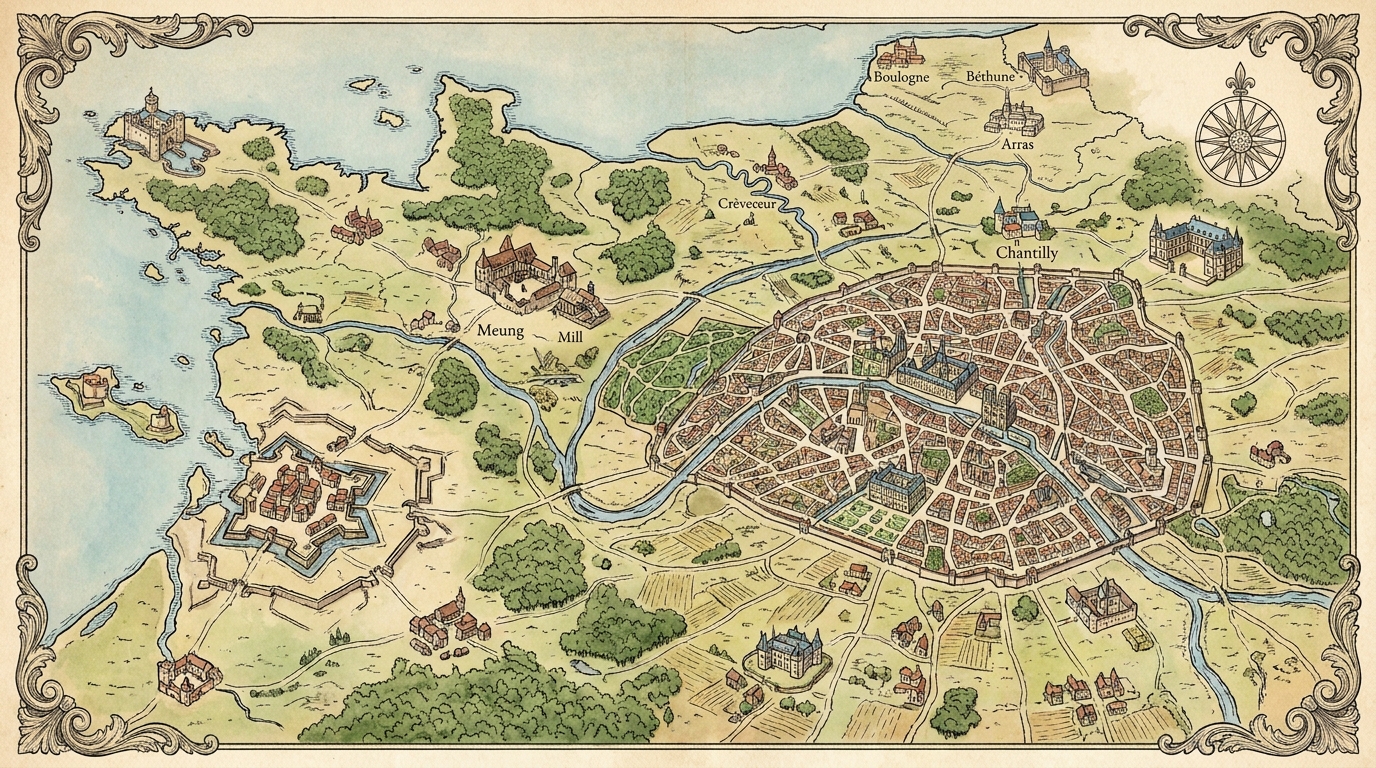
1
2
3
4
5
6
7
8
9
10
11
12
13
14
15
16
17
18
19
20
21
22
23
24
25
26
27
28
29
30
31
32
33
34
35
36
37
38
39
40
41
42
43
44
45
46
47
48
49
50
51
52
53
54
55
56
57
58
59
60
61
62
63
64
65
66
67
68
69
70
71
72
73
74
75
76
77
🖱 wheel to zoom · drag to navigate
Want the same for your book?
Upload a book